The Caboclo of the Alto Tejo
Chico da Silva's origins: a birth without records on the Alto Tejo in Acre, a childhood on the rivers, and the road to Fortaleza and the Pirambu School.
Chico da Silva had no birth certificate, and the year of his birth changes with whoever tells it. His identity card and most catalogue chronologies say 1910. Estrigas, a Ceará painter and memoirist who knew him, argued in 1988 that the real year was 1922 and blamed the 1910 on a faulty entry in Roberto Pontual’s dictionary of Brazilian art. The painter himself was no help: in interviews he told Roberto Galvão 1914 or 1916, and in 1966 he gave a Correio da Manhã reporter the year 1928, an estimate the paper was careful to flag as his own; in 1972 he handed the critic Luiz Ernesto Kawall a complete date, 2 May 1928. Jean-Pierre Chabloz, the Swiss artist who later carried his work to Europe, settled the question in his own way and described him as an artist without a civil registry.
The João Cunha Collection keeps the question open. Not knowing when Chico da Silva was born is the first true fact about him: he came into the world far from any registry office, in a place the Brazilian state had barely reached.
The Alto Tejo
The place is better established than the date. He was born on the banks of the rio Tejo, in the upper stretch that names the region, in what was then the federal Território do Acre, close to the Peruvian border. The land today belongs to the municipality of Marechal Thaumaturgo. His mother, Minervina Félix de Lima, was from Ceará and had fled drought for the Amazon rubber boom, the “Amazonian eldorado” in the words of the researcher Gerciane Oliveira. His father was a Peruvian indigenous man of probable Kampa origin, Domingos da Silva in Galvão’s record and in the telling of Chico himself, who in 1973 described him as the “Peruvian caboclo Domingos Silva”; Oliveira gives him the same name as his son, Francisco Domingos da Silva, while Estrigas records the first name as Luiz. Of the father, and of those first years in the forest, little survived beyond an image the painter repeated all his life: living on the rivers, up and down, at the side of a father he described to Kawall as a Peruvian who owned boats.
Memory or invention
For decades critics read his painting as memory: the poor adult in Fortaleza returning on paper to the fish, snakes and birds of the Amazon of his infancy. Chico rejected the reading. The worlds he painted, he told Luiz Ernesto Kawall in October 1972, in an interview Roberto Galvão also collected in 1986, were not recollections of childhood; he called them imagination, occult sciences, astronomy, and insisted that as a boy he saw none of it, only the rivers and his father. The fauna he set down in gouache decades later, like the peacock, the blue-headed bird and the butterfly of this sheet from around 1969, belongs to that invented zoology rather than to any documented riverbank.
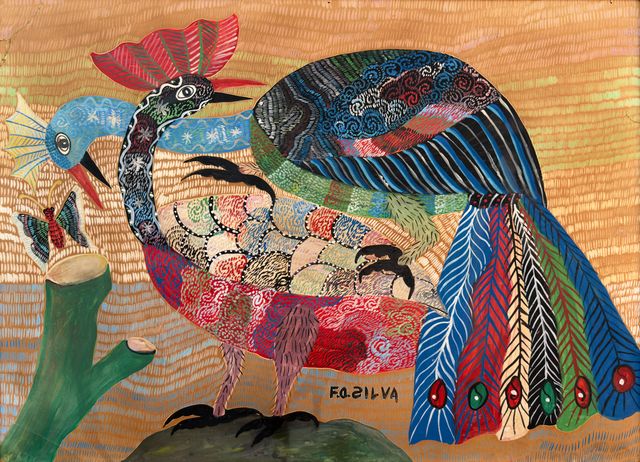
Taking him at his word matters. Histories of Brazilian popular art tend to file him under naïve art, a label that assumes an untutored eye copying a remembered world. His own account describes something else: a painter who never accepted the border between what existed and what could be imagined.
Crossing to Ceará
The move from Acre to Ceará was made of losses. Around the age of six, Chico was taken with his mother to Quixadá, her hometown in the Ceará backlands. His father died there, bitten by a rattlesnake, as Estrigas records. Mother and son later climbed into the hills of Guaramiranga, where the adolescent worked the banana and coffee groves of the Uruguaiana farm of Maria Libânia Holanda, according to Galvão. Estrigas tells the same journey on another calendar, with the mother probably leaving Ceará in the drought of 1919 and returning in 1935. The places match across the sources; the dates rarely do.
In the mid-1930s the two came down to Fortaleza and settled in Pirambu, a strip of dunes and lagoons on the city’s western shore where drought migrants were pushed. Chico lived there for the rest of his life, and the district’s name later attached itself to the Pirambu School, the collective workshop that formed around him in the 1960s.
A wall in Fortaleza
Before he painted, he worked at whatever fed him. The lists his interviewers took down include ship’s steward, clog maker, umbrella mender, watch repairer and repentista singer; telling his life to Kawall in 1972, he added deep-sea diver and barber to the list. Around 1937, on a whitewashed wall at Praia Formosa, a fishing beach below the city centre, he began to draw. Those first murals of charcoal, brick and crushed leaves are the subject of The murals of Praia Formosa; the Swiss painter who stopped in front of them in 1943 is the subject of Chabloz and the discovery.
The two ends of his life stay uneven: a birth somewhere between 1910 and 1922, a death recorded with precision in Fortaleza on 6 December 1985. The biography follows the whole arc. The paintings in the collection, gouaches on paper and acrylics on canvas, show what became of the fauna he insisted he never saw as a boy.