The Murals of Praia Formosa
Fish, birds and ghost ships in charcoal on fishermen's walls in Fortaleza: how Chico da Silva's repertoire began before gouache and the Pirambu School.
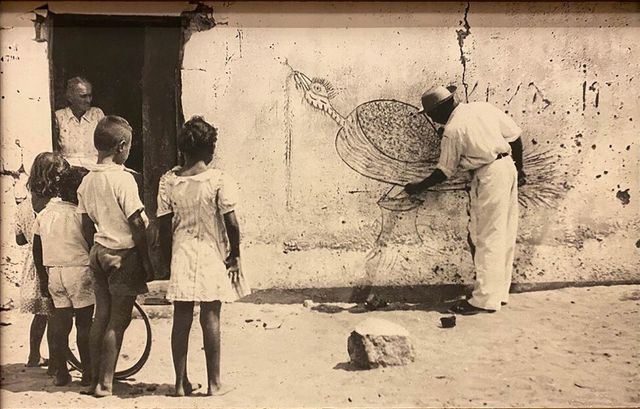
Praia Formosa was a small beach at the foot of the Passeio Público, in central Fortaleza, the capital of Ceará. Estrigas, in A saga do pintor Francisco Domingos da Silva (1988), records the other names it went by, Praia do Gasômetro and Poço da Draga. In the early 1940s a few fishermen’s families lived there in whitewashed houses, and on those white walls large drawings kept appearing: fish, birds, ships. They were the first known works of Chico da Silva. None survives.
A house painter’s other walls
Roberto Galvão, in Chico da Silva e a Escola do Pirambu, dates the beginning to 1937, when Chico earned his living painting walls and, at times, covered a freshly limed surface with animals of his own invention. Chico repeated the date himself: “Em 1937 eu era pintor de paredes e de muros”, his answer to a questionnaire by the painter Heloísa Juaçaba that Estrigas reproduces. In 1972 he described one of those mornings to the Jornal do Comércio: he went out at five, leaned against a newly whitewashed wall and painted an Amazonian legend, a very large bird, a sloth, a vulture, a snake. When the magazine Vida das Artes asked him in 1975 why he painted walls, the whole answer was “Fazia bem à vista”: it did the eyes good.
The chronology has loose ends. Galvão has him drawing on walls by 1937; Estrigas puts the family’s arrival in Fortaleza around 1940, after years in Quixadá, in the interior of Ceará. The dispute over his birth date is a story of its own, told in The Caboclo of the Alto Tejo. About the place, though, Estrigas allows no doubt: the drawings were at Praia Formosa, which Chico reached by walking along the shore from Pirambu, the district where he lived, and locating them in Pirambu is an error the press repeated for years. He also records how other painters found the walls. Aldemir Martins remembered that he and Antonio Bandeira, on their way to swim below the Passeio Público, saw drawings in charcoal and brick on a wall near the old gasworks; the two later pointed Jean-Pierre Chabloz towards them.
Charcoal, brick and leaves
There was no paint. Galvão describes large coloured drawings on the whitewashed walls of the fishermen’s shacks, made with charcoal, improvised chalks and plant pigments obtained by rubbing leaves against the lime itself. Chico gave the inventory in a 1973 interview with the Jornal da Imaculada: charcoal, green leaves, white and red brick. A year earlier he had told Luiz Ernesto Kawall much the same: chalk, charcoal and burnt clay, with the colour taken from fruits and leaves. Shards of brick and roof tile made the reds, crushed leaves the greens, charcoal the black and grey. The wall supplied the ground and, scraped and rubbed, most of the palette. Chabloz, the Swiss painter who stopped in front of the drawings in 1943, later wrote that Chico proved the method to him with a small and convincing demonstration on the beach itself.
The repertoire before the canvas
What stood on those walls is known mostly through Chabloz. In the memoir reproduced in the catalogue Chico da Silva vê Chabloz vê Chico da Silva, he recalled drawings broadly sketched in charcoal or chalk: great birds of elegant lines, somewhat monstrous fish, strange apparitions of ghost ships. What seduced him, he wrote, was their originality, their distinctly archaic style and their power of poetic evocation. The neighbours offered only a rumour about a caboclo who amused himself scribbling on the walls and vanished without leaving an address. The labels, arte naïf, Brazilian popular art, came afterwards; on the beach there were only the drawings.
The repertoire even gained an extra support: in July 1945 the painter Mário Baratta, writing in O Estado, praised the decorations “F. Silva” was making on clay vases, “fantastic birds, legendary snakes, Yaras, giritiranas-bola”, painted, he wrote, with an ingenuousness only a primitive could have. That 1943 inventory reads like a list of what Chico would paint for the next four decades: the fish, the birds, the ships, the bestiary that the group later known as the Pirambu School would multiply in the 1960s. Rinha de Galos (1969), a gouache in the João Cunha Collection, is that repertoire a quarter century on, the great birds of the walls now set against each other. In the catalogue of the MIS-CE exhibition of 2024, the educator Alisson Freitas reads a 1969 cockfight by Chico through his father’s memories of boys pitting their roosters in Pirambu.

From lime to gouache
The author of the drawings took months to appear. Estrigas records that Chico hid from the foreigner asking after him because he feared being punished for scratching other people’s walls; in Galvão’s telling, Chabloz turned out, to Chico’s surprise, to be neither the owner of the walls nor inclined to complain. The encounter and its consequences are the subject of Chabloz and the discovery. What matters here is the change of support. Chabloz handed over gouache and paper, and Chico left the walls for a portable format with a far wider range of colour. Estrigas condensed the move into one sentence: once paper arrived, his pictures went where the walls could not.
Chabloz kept a reservation about that exchange. Mural, he wrote years later, had been the point of departure of Chico’s free artistic expression and should, in his view, have been its logical outcome; he imagined him initiated into the technique of fresco. It never happened. Gouache on paper, later on canvas, is the medium in which the work exists and in which it can be seen today among the paintings. Briga de Galos (1972), a gouache on canvas, carries the wall-born motif into that later format.

What remains of the walls
Materially, nothing. Galvão writes that the years before the meeting with Chabloz left no works and no records; what exists are verbal accounts and a few photographs Chabloz took of a work in progress, during his second stay in Ceará between 1945 and 1947. The beach changed as well: Estrigas notes that Praia Formosa is now flanked by Avenida Leste-Oeste. The catalogue Chico da Silva vê Chabloz vê Chico da Silva reproduces a 1940s photograph of the beach, from the Nirez archive: sand, rafts and the few houses whose walls this chapter is about.
In the retellings, the murals kept their place at the origin of the work. When Pedro Jorge de Castro’s short documentary about Chico circulated in 1976 and 1977, a screening program introduced him through the walls: he painted on the fishermen’s shacks, it explained, because he lived facing the sea. The life that led to that beach and away from it is told in the biography; the repertoire born on lime is visible in the paintings of the João Cunha Collection.