Biography of Chico da Silva
Chico da Silva was a Brazilian painter. He was born in the Amazon, drew on the walls of a fishing neighborhood in Fortaleza, learned gouache at the hands of a Swiss painter and in 1966 received an honorable mention at the Venice Biennale. At the height of his fame he turned his own studio into a collective workshop with the boys of the neighborhood, and the question of where his hand ends and his disciples’ begins has occupied the critics since 1966, when the first authorship scandal reached the newspapers.
He died poor in 1985, and for the decades that followed his name was kept mostly by Ceará. Since the 2020s, retrospectives at the Pinacotecas of São Paulo and Ceará, shows in New York, Shanghai and the United Kingdom, and artists who name him as an influence, from Denilson Baniwa to Jaider Esbell, have returned his name to the international circuit. This biography tells that life with the sources in view: the newspapers and magazines that covered him while he lived, the books and catalogs that studied him, and the research still under way.
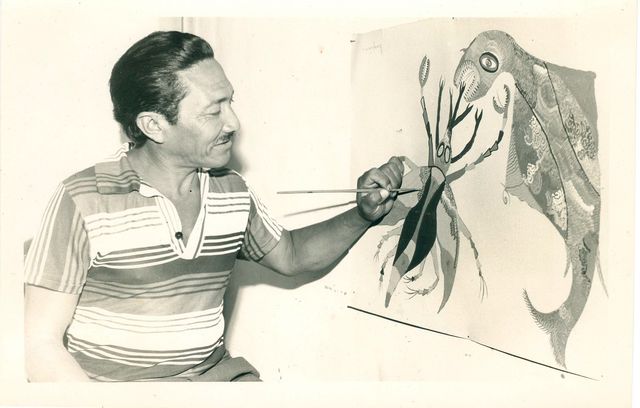
Origins on the Alto Tejo
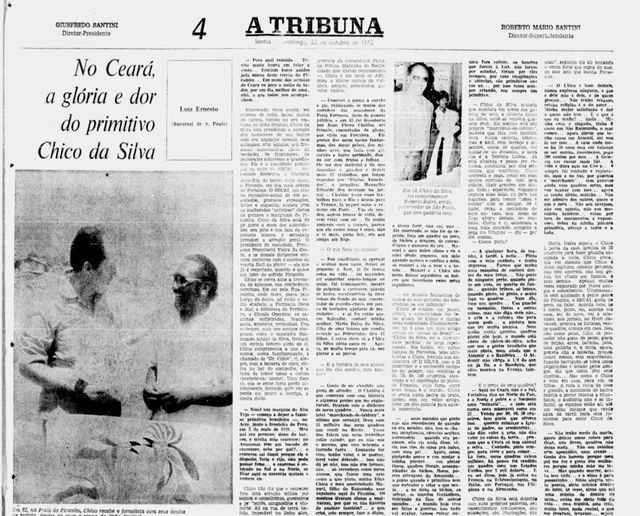
Chico da Silva was born around 1910 on the Alto Tejo, on the banks of the Tejo river, in the Acre Territory, near the border with Peru, on land that then belonged to Cruzeiro do Sul and today is part of Marechal Thaumaturgo.1 The year is uncertain, and the uncertainty is itself a trait of the biography: he had no birth certificate, the date changed with whoever told it, and the documents do not help. His identity card and most catalogs say 1910; the catalog of his first solo show, in 1961, gives March 16, 1922, the date he himself gave the magazine O Cruzeiro in 1963; to the Correio da Manhã, in 1966, he reckoned 1928; to the critic Luiz Ernesto Kawall, in 1972, he gave May 2, 1928; and the critic Estrigas, who knew him, argued for 1922 or 1923 and put the 1910 down to a dictionary error that passed from catalog to catalog.2345 Even the alternative press of the 1970s had its own version: the paper Movimento gave 1926.6
His father was a Peruvian caboclo of probable Kampa origin whom the records name as Domingos da Silva, or Luiz Domingos da Silva; his mother, Minervina Félix de Lima, was a woman from Ceará who had followed the rubber trade into the Amazon.72 According to the son, the father had boats and took him along on the river journeys.4 The family went back to the mother’s home state while he was still a boy, and the father died in Ceará, bitten by a rattlesnake in Quixadá.7 After Quixadá and the hills of Guaramiranga, where he worked on a smallholding, he reached Fortaleza as a young man; his age at the move runs from six to seventeen depending on the source and the interview.78
He took the name Francisco Domingos da Silva and lived in Pirambu, at the time a strip of dunes and fishermen’s shacks on the west side of the city. He could not read or write all his life: as a grown man, at the university museum, he learned to draw his own signature.9 Before he lived by painting he earned his bread as he could. “I was not only a painter. I have done many things in life… I was a shoemaker, a barber,” he recalled, in the collection of sayings Roberto Galvão gathered for the obituary in O Povo; the period lists add clog-maker, umbrella-mender, tinsmith, upholsterer.1011 A profile published in Fortaleza in 1967, when he was already selling through a gallery, still introduced him as the shoemaker who had taken to painting in his spare time, and recorded the line with which he explained leaving the only formal job of his life: “I am not a man to work for a boss.”12
The walls of Praia Formosa
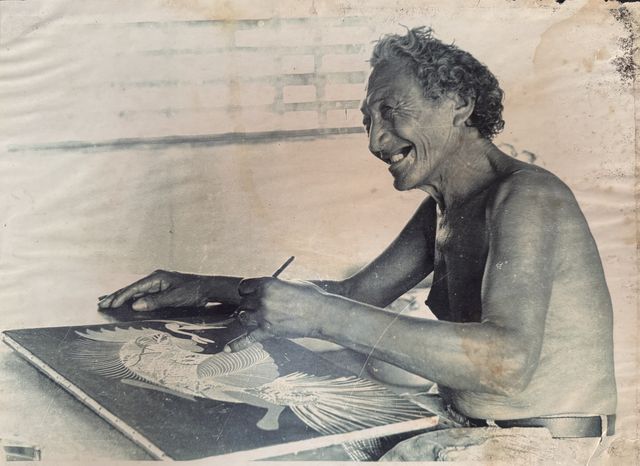
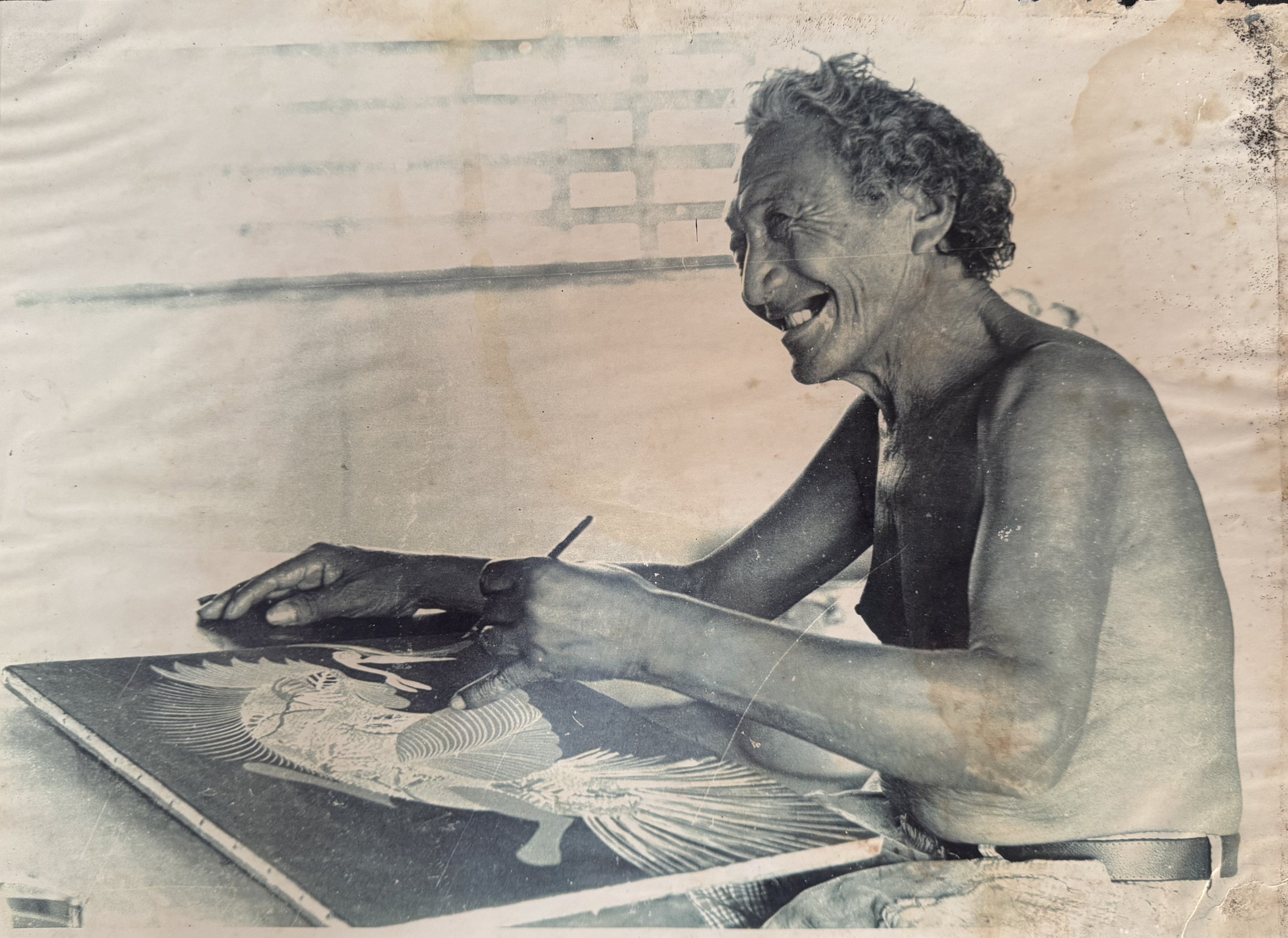
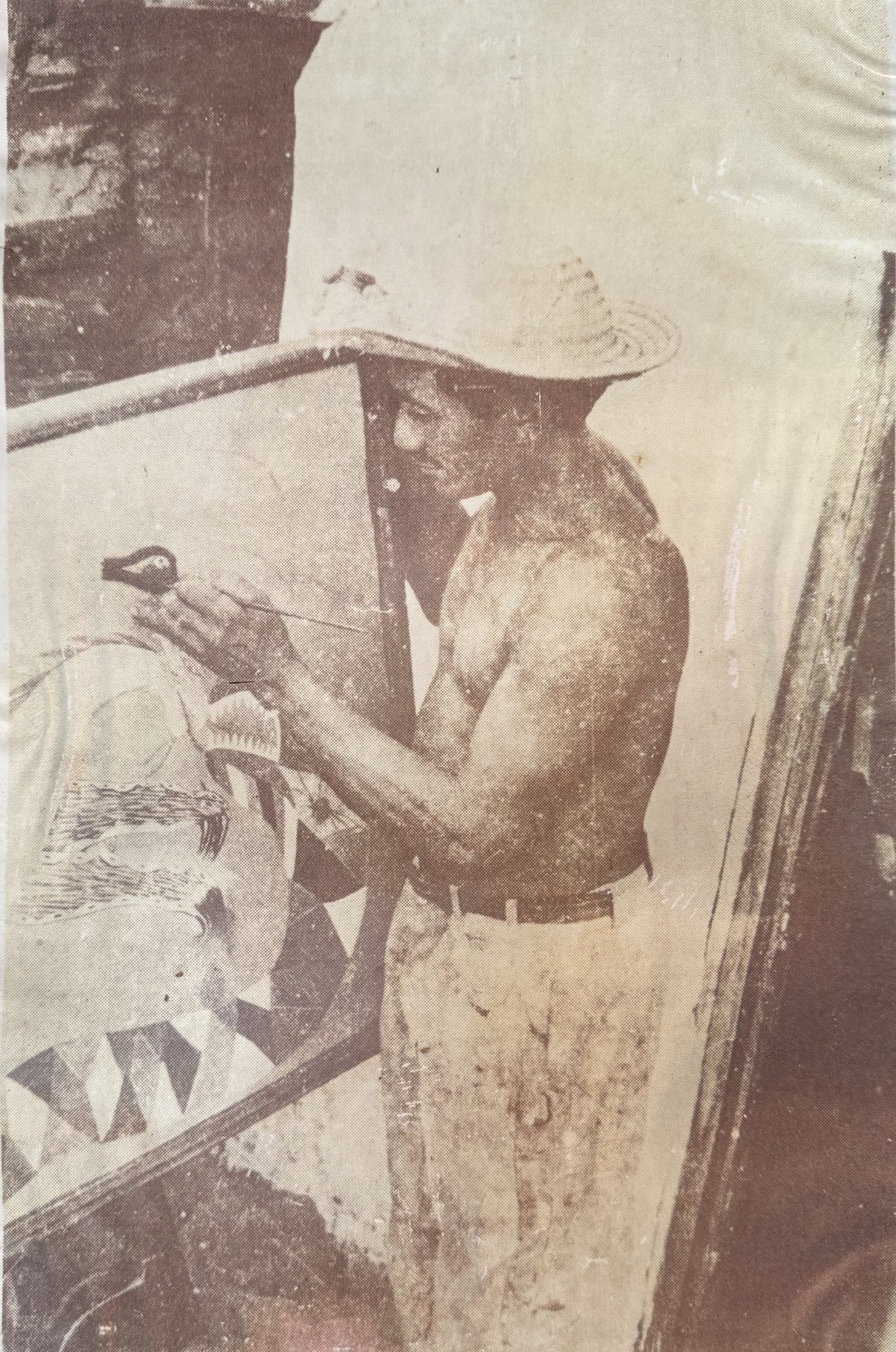
Around 1937 he began drawing on the whitewashed walls of the shacks at Praia Formosa, near the Passeio Público and the Poço da Draga.13 The material was whatever was at hand: charcoal, chalk, shards of brick and roof tile. Fish, serpents, birds, ghost ships. Years later he would say the urge came from the wall itself: “when I saw a whitewashed wall, I felt […] the urge to paint.”14 From that wall repertoire he also dated his first picture, Um Dragão Comendo Arraia (A Dragon Eating a Ray), of 1937.215
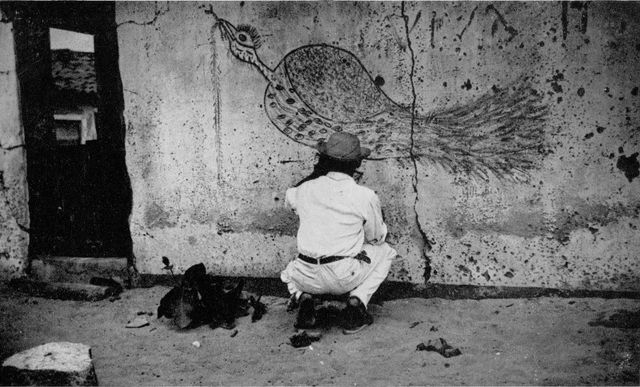
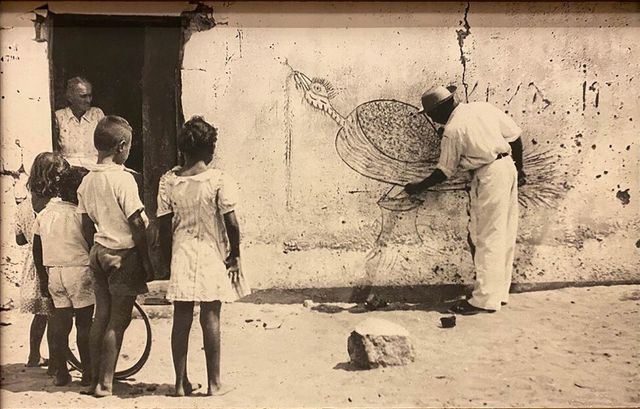
High-resolution viewer. Use the arrow keys to pan, plus and minus to zoom.
Before he was known, the word in the neighborhood was that he was feeble-minded. Estrigas refused the assessment and described a lively, skillful man with no schooling and nothing more than that.16 Whoever passed through Praia Formosa saw the finished drawing and not the author: “it’s a little Indian who comes by here every day, he scribbles and scribbles and goes away,” the residents answered anyone who asked, in the version the press repeated for decades.1517 One stray sale preceded any career: according to Estrigas, he sold his first picture in 1942, for 1,500 cruzeiros.18
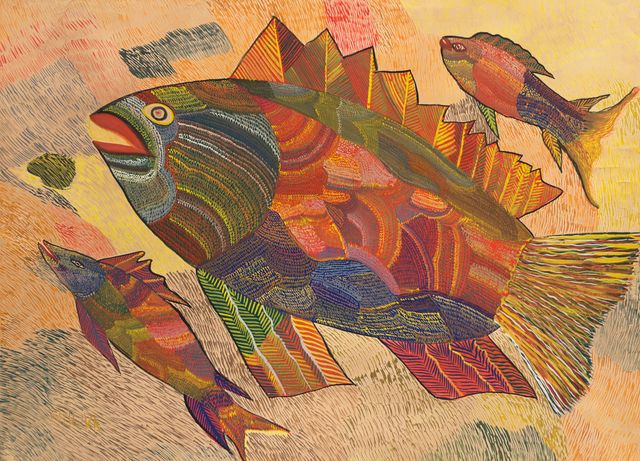
Chabloz and gouache
In 1943 the Swiss painter Jean-Pierre Chabloz, in Fortaleza on assignment for the Rubber Campaign, saw the drawings on the walls of Praia Formosa. The place would become urban legend with the addresses switched, and it was Chabloz himself who fixed it, in a signed statement in the Jornal do Brasil in 1969: it was at Praia Formosa, he wrote, “and not in Pirambu, nor on Iracema beach, as several newspapers have stated.”19 He left word with the residents, and the two met months later; Chico’s distrust delayed the first contact.20 Chabloz commissioned works on paper, handed over the material and paid in advance: sheets of bristol board, India ink, gouache, pastel, pencils, pens and brushes.21 Over his stays of 1943 to 1945 and 1947 to 1948 he gathered some twenty gouaches into a collection of his own.22
High-resolution viewer. Use the arrow keys to pan, plus and minus to zoom.
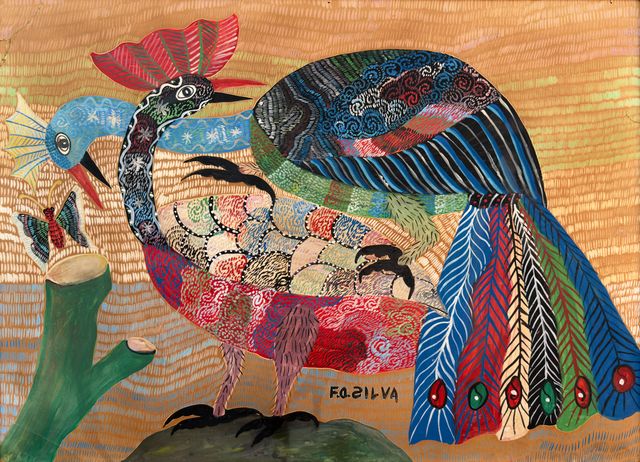
The first gouaches entered the Fortaleza salons in 1944, at the III Salão Cearense de Pintura, organized by Chabloz himself, and at the II Salão de Abril.23 A group show of Ceará artists at the Galeria Askanasy in Rio, in 1945, which the political scientist David Silberstein records as the first modern art gallery in Brazil, brought the first national review: for Rubem Navarra, who signed the catalog presentation, those gouaches were “something very serious,” from “a kind of Dalí in a state of nature.”2425 From Fortaleza, the painter Mário Baratta answered in the columns of O Estado in July 1945: where Navarra saw a Dalí, he saw “far greater affinities” with Raoul Dufy.26
Selling was another story. There was no art market in Fortaleza in that decade, and the pictures circulated as gifts among the city’s cultural elite; the specialized trade would only appear in the 1960s, with the painter himself among the first names to sustain it.2728 The economic reading is Silberstein’s, for whom the pause that came next was also a lack of buyers.27 When Chabloz sailed back to Europe, in August 1948, taking the collection with him, Chico put down the brushes.29
Europe without him
The collection traveled without the painter. Chabloz showed the gouaches at the Salle Beauregard in Geneva in the fall of 1949, and the Journal de Genève announced the show in October, on view until the 12th.30 Then came Lisbon, at the Palácio Foz, in 1951, at the invitation of António Ferro’s propaganda office, and the solo show at the Galerie Pour L’Art in Lausanne in 1952, the year the Paris gallery Jeanne Bucher went as far as scheduling a show and gave it up when Chabloz refused to cede the right to sell the works.31 Later chronologies shuffle these dates, and the O Povo obituary gives Lausanne as 1950; this text follows the chronology revised by recent research.10
In Paris, Chabloz put the gouaches before the critic Christian Zervos and André Malraux, who answered by letter with a sentence he would display for the rest of his life: “Je souhaite vivement que vous obteniez que lui soient confiés des murs!”, I earnestly hope you succeed in having walls entrusted to him.19 In December 1952 the magazine Cahiers d’Art published the essay “Un indien brésilien réinvente la peinture,” a Brazilian Indian reinvents painting, with the endorsement of Zervos, its editor.326 From November 1955 to February 1956 the work was in “Le Brésil,” a panoramic show of Brazilian art, from the “primitives” to the moderns, with which the Musée d’ethnographie de Neuchâtel, in Switzerland, opened its exhibition hall, and the museum acquired pieces from the collection.3334

The pictures crossed all those borders; Chico never left Brazil. Fame reached him as fable, and he returned it enlarged: he said he had been received by Queen Elizabeth at Buckingham Palace, greeted by De Gaulle, that he had known Germany, the United States and a fantastic country he called Juberlano.35 Journalists who asked for proof saw, in 1969 and again in 1977, the same document: a passport without a single exit visa, expired since 1967.3637 “His pictures went; he did not travel,” Movimento summed it up.6
Ten years of silence
Between Chabloz’s departure in 1948 and the end of the following decade, Chico hardly painted. Roberto Galvão writes that the pause lasted more than ten years, and records that the gap led part of the public to believe the career had only begun in the 1960s.38 The 2001 state catalog gives the reason as encouragement that was missing; Silberstein translates it into economics: with no local market, the gouaches of the 1940s had circulated as courtesy among the elite, and there was no one to buy the next ones.2227 The silence was so complete that the O Povo obituary would record it as an abandonment “of more than ten years.”10
In those years he went on living by the manual trades, invisible to the circuit. The local press would only register movement again in March 1960, when it reported Chabloz’s return to Fortaleza.39
The university and the market
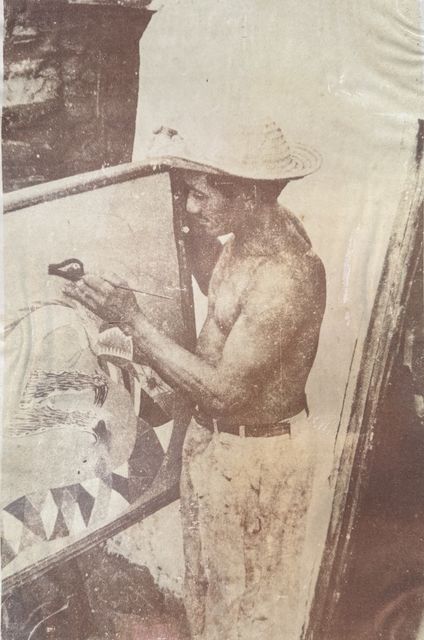
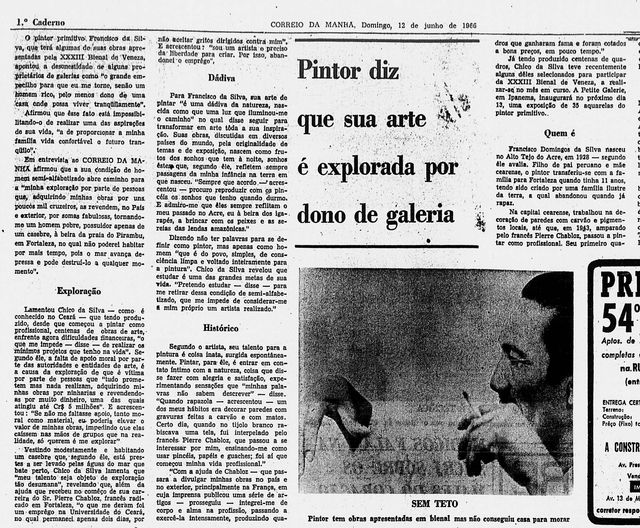
Chabloz came back in November 1959, found Chico not painting, and introduced him to Antônio Martins Filho, rector of the University of Ceará, who was setting up the institution’s art museum, the MAUC, and hired him.40 Chico began painting on the museum’s own premises, on a salary paid by the rector, and out of that came the group of some forty gouaches that is still the undisputed core of that collection.4012 The painter’s version of the job was another, and it changed over the years: to the Correio da Manhã, in 1966, he said he had stayed two days and left because he would not take shouting; to the Unitário, in 1967, he summed up that he was not a man to work for a boss.312
High-resolution viewer. Use the arrow keys to pan, plus and minus to zoom.
The first solo show opened on April 10, 1961, at the headquarters of the Diários Associados, presented by governor Parsifal Barroso, and ran for a week; Estrigas counts ten works, the painter remembered seventeen.414 Two months later, on June 25, he was in the university museum’s inaugural exhibition, with six gouaches.41 By 1962 the Jornal do Brasil placed him, beside Mestre Vitalino and Chico Santeiro, in the “famous trio of the most authentic popular artists of the Northeast.”42
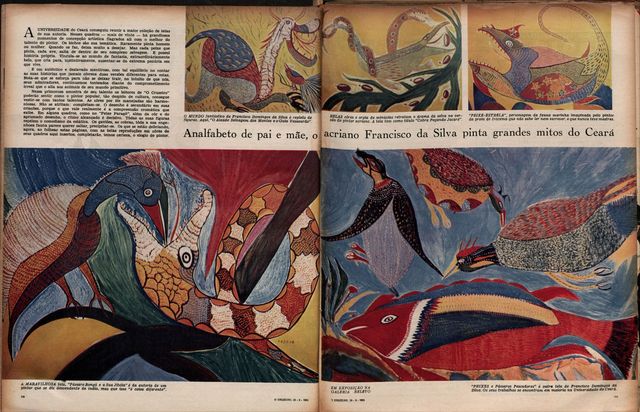
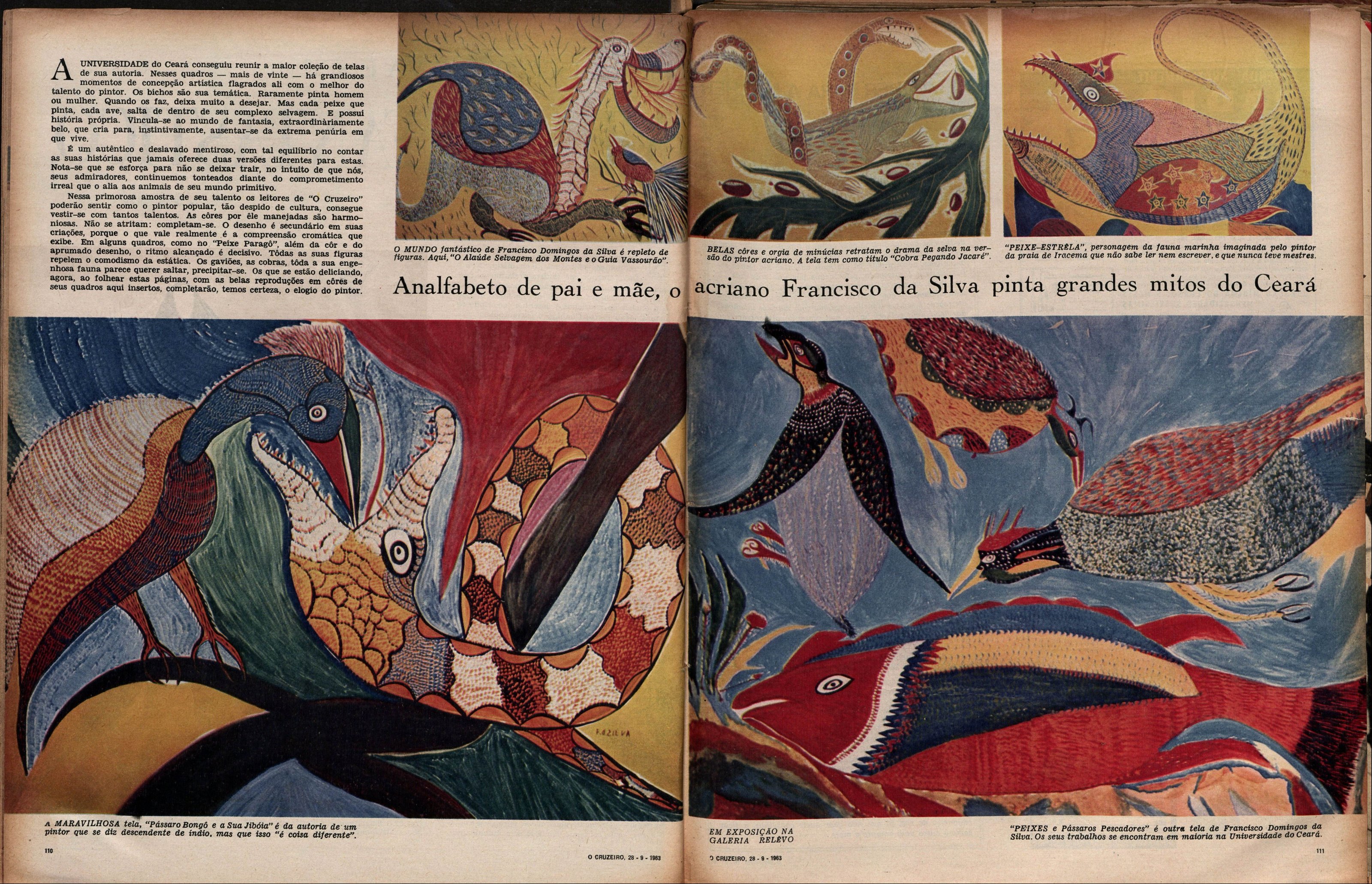
Around 1963 he grew close to Henrique Bluhm, a German opera singer who owned a snack bar in downtown Fortaleza, who became his first dealer and organized shows in Rio and São Paulo.4344 In September 1963 a solo show at the Galeria Relevo, in Rio, organized by Jean Boghici, opened the Southeast market to him, and that same month the magazine O Cruzeiro ran a color feature, “Francisco da Silva e seu Mundo Fantástico,” that carried his name to newsstands across the country.452 After Bluhm came Maurício Xerez and José Edilson Pitombeira, known as Dão.43 By 1965 his pictures were showing in Salvador, São Paulo, Rio and Paris, and a Fortaleza profile noted the going price: 120 new cruzeiros at the local gallery, four to five hundred abroad.4612 Chabloz, who had returned in November 1962, drew away from him in those years, uninterested in what he called feats “more worldly than artistic.”47
High-resolution viewer. Use the arrow keys to pan, plus and minus to zoom.
Venice, 1966
The critic Clarival do Prado Valladares chose Chico for the Brazilian delegation to the 33rd Venice Biennale, setting aside in January 1966 twelve gouaches from the university museum’s collection.48 He met resistance inside his own delegation, a story he told in a letter that September: he wrote that he had been “terribly fought” by Brazilians opposed to the painter’s presence.49 While the Biennale ran, a show of 35 watercolors by the painter opened in Rio, at the Petite Galerie in Ipanema, with a presentation by Valladares himself, who signed the defense: “Francisco Domingos da Silva has nothing of the primary about him, as a painter. He is a professional with almost thirty years of practice, developed in a single technique and in a very personal inventive language.”503
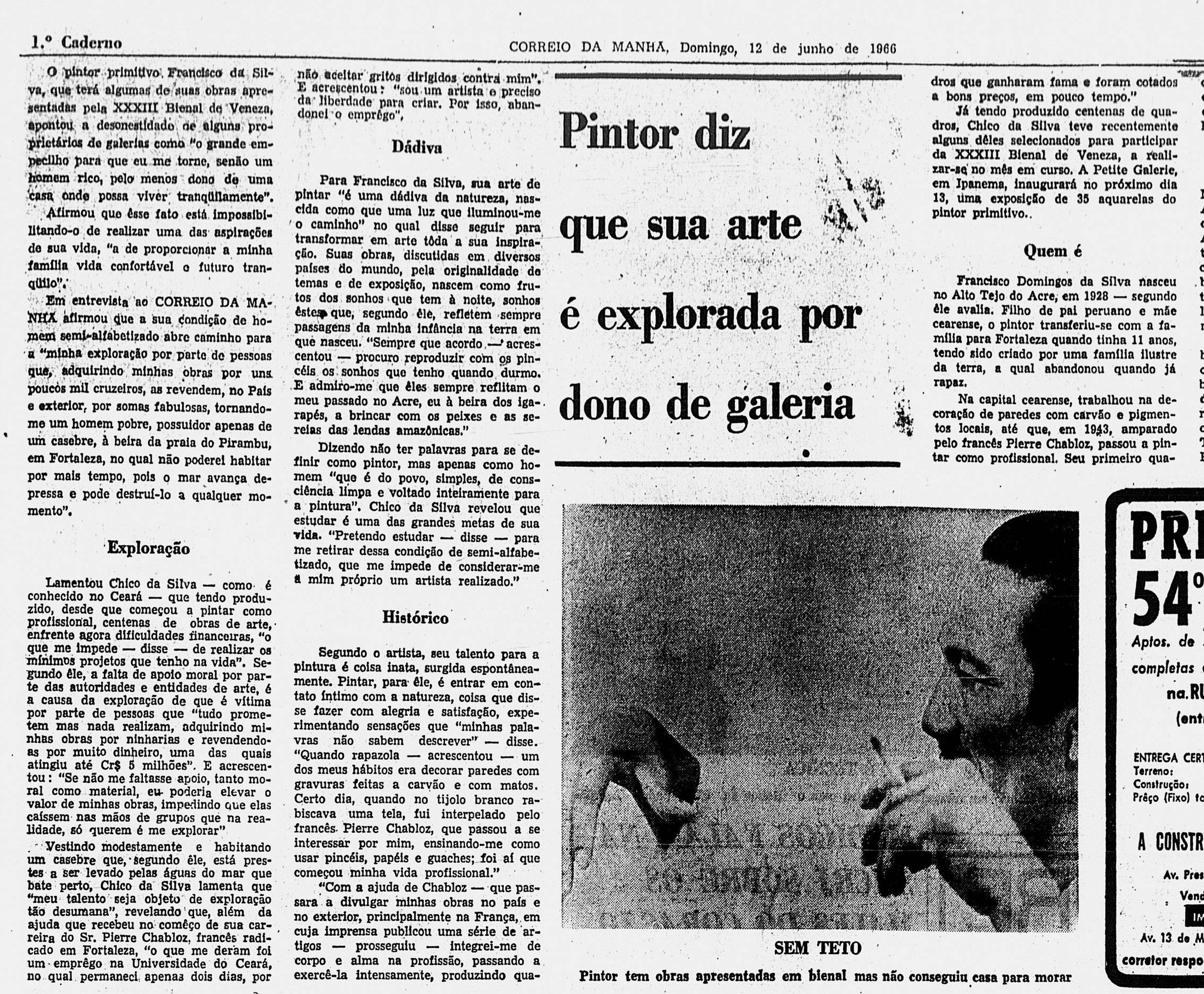
High-resolution viewer. Use the arrow keys to pan, plus and minus to zoom.
Four gouaches were hung, and the Biennale’s historical archive names them: Serpente della serra luminosa, Uccello e pesce “roni”, Drago con serpente and Tronco d’albero con serpente.51 Valladares’s letter tells the rest: reduced to a minimum of space, he watched the museum’s twelve gouaches stay off the walls, until a jury member sought him out in secret and had him show them to five jurors; the Brazilian commission, consulted as was the custom, refused its blessing to the distinction.49 The jury granted the honorable mention anyway, and Valladares described it as unprecedented for a primitive painter in the history of the show; Estrigas records it as the only prize Chico received in his whole life.4952 Not even the prize escaped the confusion that trailed everything in the Chico da Silva case: Movimento would state in 1977 that there had been no prize at all, only a mention from the critics, and the physical decoration never reached the painter’s hands. In July 1974 the Correio do Ceará reported that the mayor of Fortaleza was still arranging to send the painter to Guanabara to receive it at last.653 The year after the Biennale came the IX Bienal de São Paulo, and with it the group shows of primitives in Rio, where O Globo called him “the poet of the Dragons of Independence.”5455
The Pirambu School
High-resolution viewer. Use the arrow keys to pan, plus and minus to zoom.
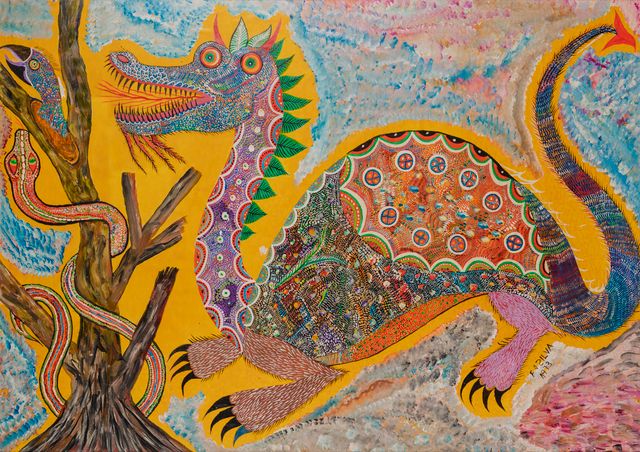
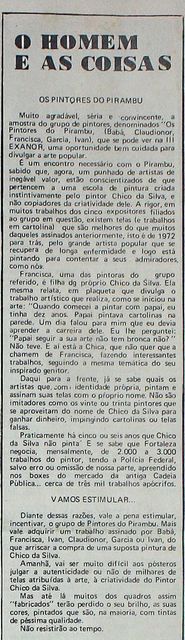
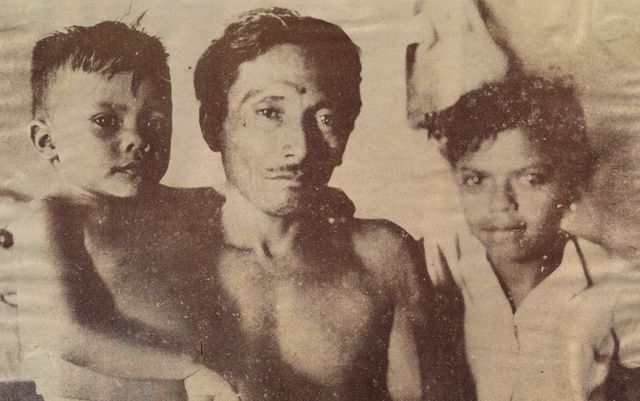
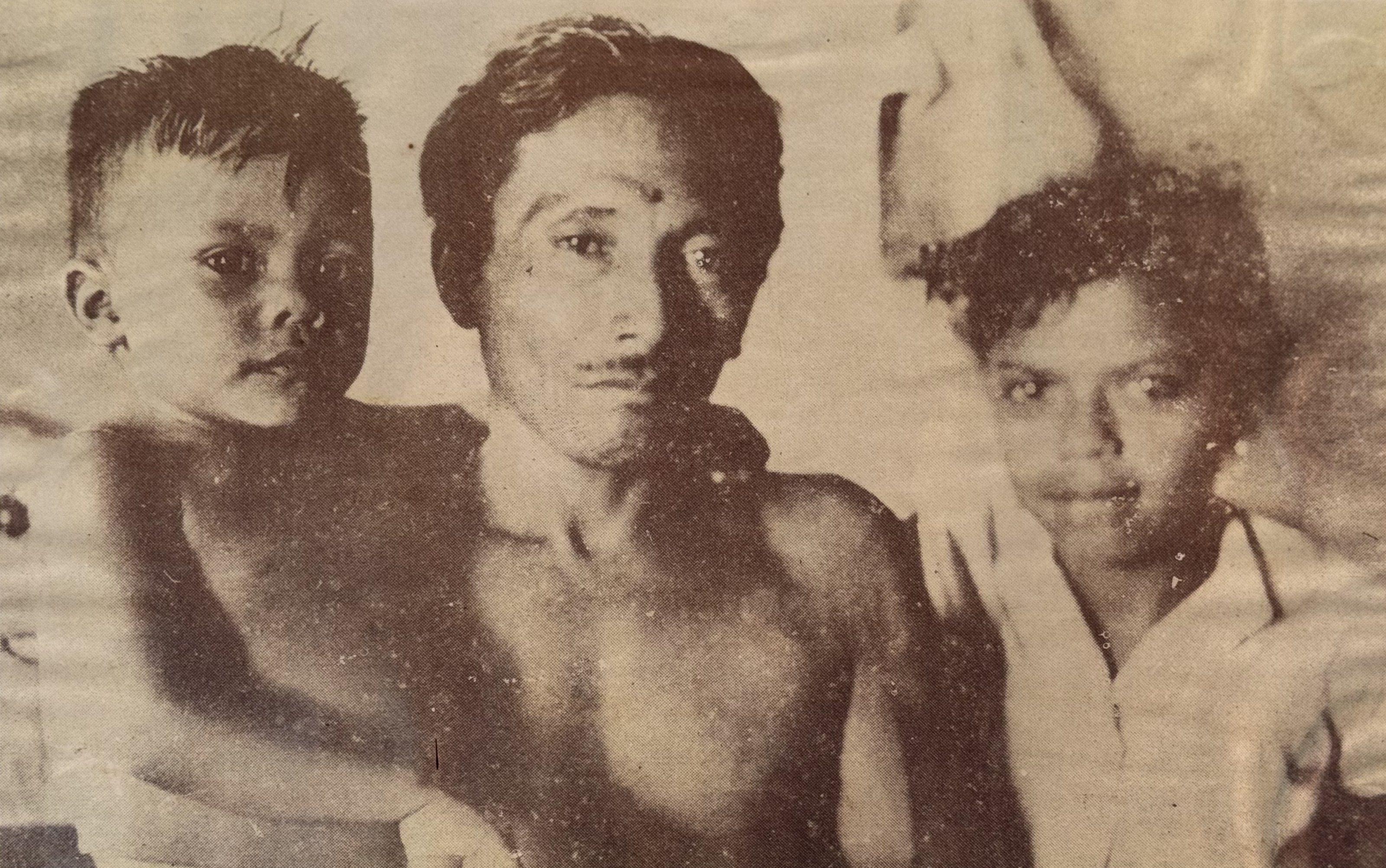
Demand outran what he could deliver, and between the end of 1963 and the start of 1964 he began working with helpers, boys from the neighborhood.56 The original core had five names, aged twelve to eighteen: Babá (Sebastião Lima da Silva), Claudionor (José Claudionor Nogueira), Garcia (José dos Santos Gomes), Ivan de Assis (Ivan José de Assis) and Chica, Francisca, the painter’s daughter; a Fortaleza paper would name them, one by one, as early as 1977, and again two days after the master’s death.575859 The work was divided by stage: the outline drawing, the filling of the colors, the stippling, and at the end the finish, which he kept for himself, with the coat of varnish laid on with a flit gun, the signature and the sale.6061
The apprenticeship went by steps: first the apprentice filled in the sketches, then moved on to the pigmentation, and only then could he create creatures of his own.60 Everyone was paid for the stage executed, and how much they were paid is the point where the memories disagree: Chica said in 1977 that she had started at ten, before the age range Galvão records for the group, and that she earned thirty cruzeiros for her first picture, sold for a hundred; an old resident of the neighborhood remembers the master handing out part of the money “to the kids” at every sale.6263 Each brought a motif of his own to the repertoire: Babá’s mandala seaweed, Ivan’s mythological animals, Claudionor’s human figure, Chica’s rosettes, Raimundo Neto’s monochrome gradient.64 Babá’s way of painting ended up as the standard the whole school pursued, and Galvão records that some considered it better than the master’s.65
High-resolution viewer. Use the arrow keys to pan, plus and minus to zoom.
The studio worked in anonymity. When a client’s car pulled up at the door, the helpers had to leave through the backyard fence, because he did not want the clientele to know about the workshop.66 Roberto Galvão names twenty-seven people who painted as Chico da Silva, among disciples, relatives and workers in the parallel workshops; a 1976 report counted 28 copyists in Pirambu alone, with names.6768 In May 1975 the Tribuna do Ceará put the size of the phenomenon on its front page: “Pirambu: todos pintam ‘Chico da Silva’” (Pirambu: everyone paints “Chico da Silva”), with the estimate of five hundred people in the neighborhood living off the sale of these pictures.69 Production soon left the house: Bluhm set up a workshop of his own in 1965, where Babá painted and Chico came by at the end of the day to sign; Maurício Xerez set up the second in 1967, hiring Ivan; and a third, run by Valentin Mickaliuck, bought cards with only the drawing on them and hired an advertising painter to color them.70 It was through these workshops that canvas replaced card, being easier to work and worth more.70 They became known as the Pirambu School.
High-resolution viewer. Use the arrow keys to pan, plus and minus to zoom.
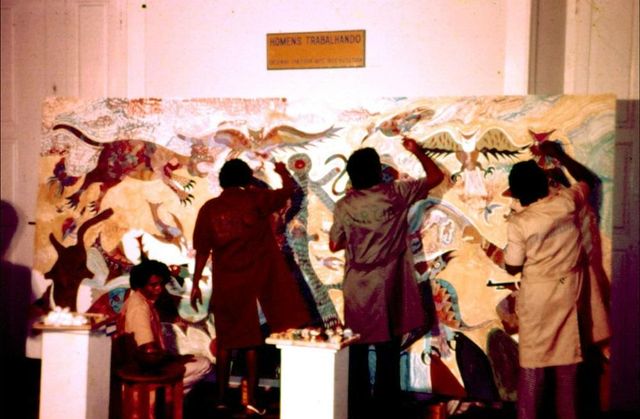
The group’s answer came in 1977. In March the five disciples exhibited at the III Exanor as “Os Pintores do Pirambu,” and it was there that they began signing the pictures with their own names; the critic Frederico Morais saluted in O Globo “the first public manifestation of a stand that may lead to a review of the Chico da Silva case.”5771 In April, before the public and over seven days, they painted with the master the panel Homens Trabalhando (Men Working), four meters by two, entered by the physician Hélio Rôla in the conceptual art category of the XXVII Salão de Abril. Chico left the hospital daily, where he was interned with cirrhosis, to work on the piece, and signed it at the end.72 The political scientist David Silberstein, who took part, compared the scene to “a small orchestra, imbued with the spirit of collective effort.”73 In 2021 a petition, and in 2022 a dossier taken to the Federal Public Prosecutor’s Office, asked that the university formally acquire the panel, kept for decades in a campus library; the agreement came in 2023, and the work entered the collection of the same museum where the painter had worked in the 1960s.74
The original group had scattered before that. Garcia went to São Paulo in 1973, because what the studio paid was not enough to live on, and only returned to painting around 2000; Claudionor stopped painting canvases because of the authenticity controversy and took it up again in the mid-2000s.7576 The reunion had a date and a patron: around 2004, Claudionor, Garcia and Babá began producing together again under the Instituto Cultural Oboé, of the businessman Newton Freitas, in a phase of large formats.7675 Claudionor died in 2010, and Garcia is today (2026) the only one of the five still living, as the 2024 book on the school records.767778
The painting factory
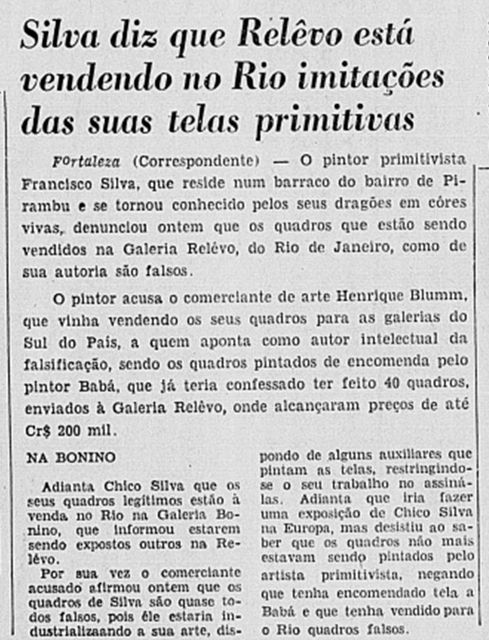
The first public scandal came in February 1966, when the Jornal do Brasil reported an accusation by Chico himself: the Galeria Relevo was said to be selling in Rio forty pictures commissioned by the dealer Henrique Bluhm from the disciple Babá. Bluhm answered in the same report: almost everything by Silva would be fake, “for he is industrializing his art.”79 That same year, with the Petite Galerie show open in Rio, Dalva, Chico’s wife, went to the police in Fortaleza to report fake pictures among those on view, and he contradicted his own wife in public and claimed the works as his.80
High-resolution viewer. Use the arrow keys to pan, plus and minus to zoom.
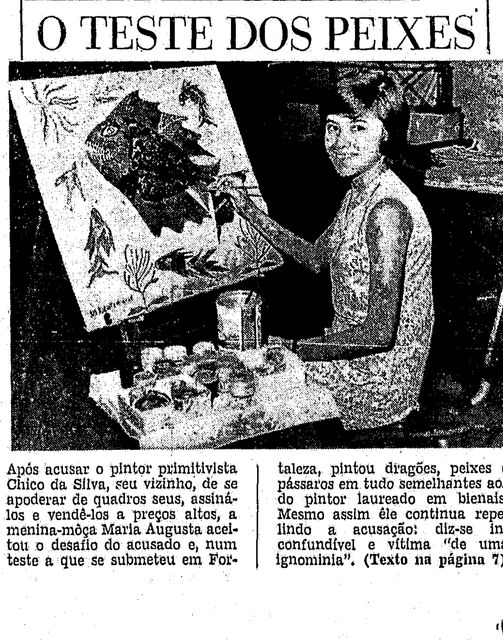
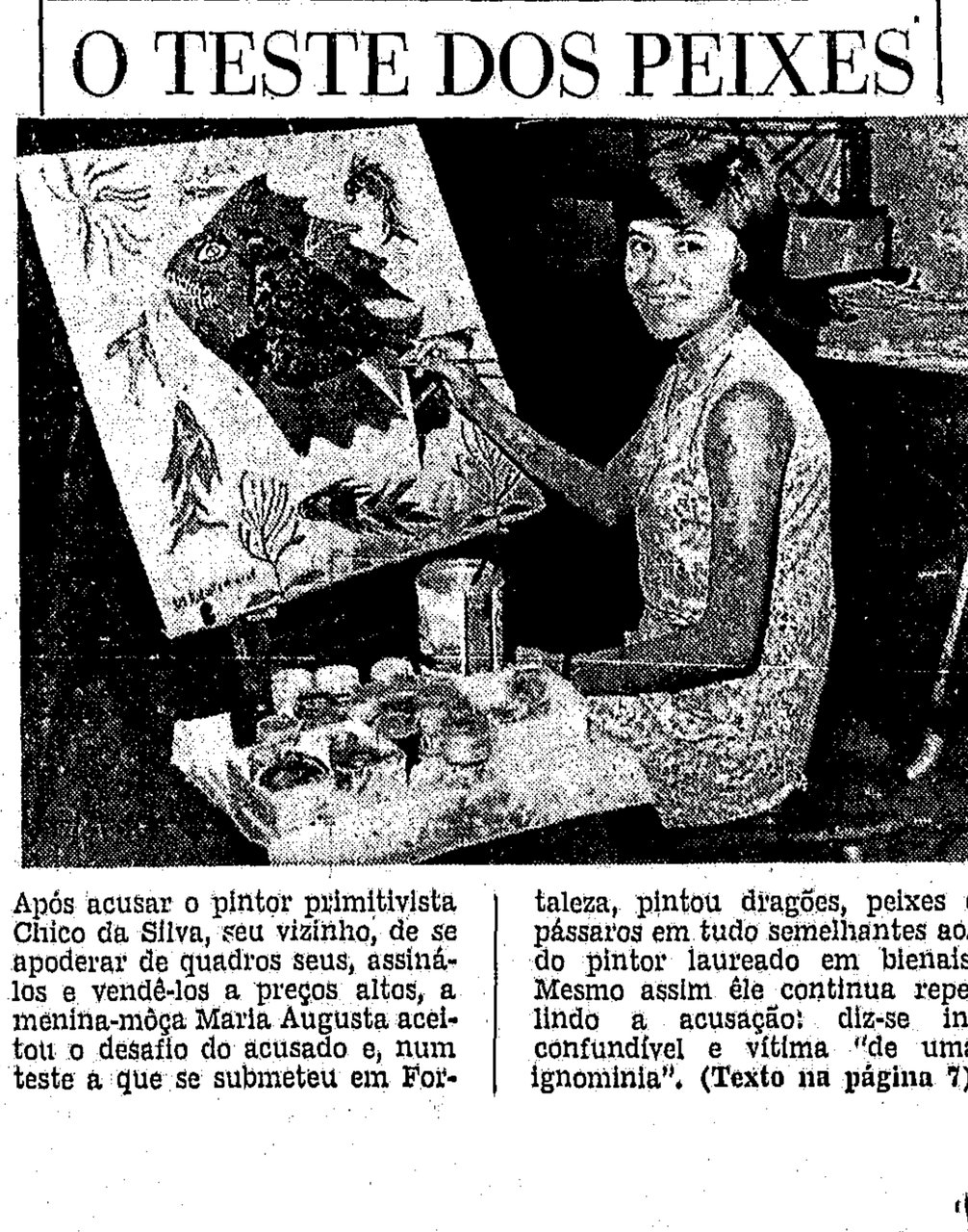
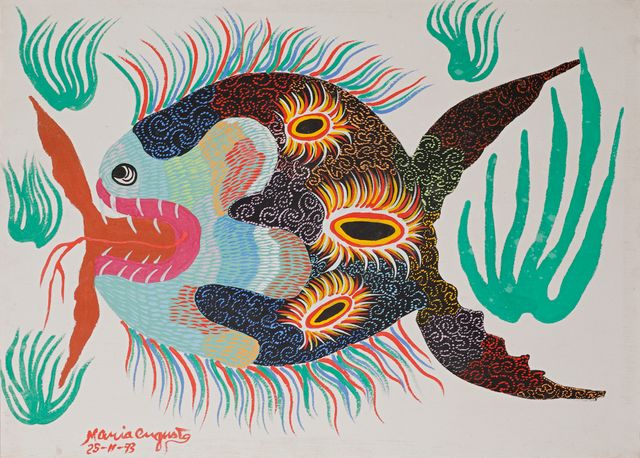
On June 12, 1969, the Gazeta de Notícias, of Fortaleza, published the statement of Maria Augusta do Carmo Moreira, fifteen years old: for almost five years she had painted pictures that Chico signed and sold.81 In six days the case was national. O Globo took to its front page the “fish test,” in which the girl, an orphan from Quixadá encouraged by a general, painted dragons, fish and birds in front of reporters, and detailed the pay: two new cruzeiros for every three works.82 “My pictures began to sell and I never caught the smell of the money,” she told the magazine O Cruzeiro, which also recorded the end of the challenge he himself had issued, to paint beside her on television: he did not show up, and she did.83 He denied everything, claimed an “unmistakable” style and offered himself “for any test”; the defense went as far as his left-handedness, as a mark no imitator could reproduce.828415
High-resolution viewer. Use the arrow keys to pan, plus and minus to zoom.
Chabloz, the man who had discovered him, declared that June that the work had become an “industry of pictures,” “beautiful trash made to delight the rich,” and nicknamed the studio the “Chico da Silva Picture Factory Ltd.”856 In August, in a signed article in the Jornal do Brasil, he wrote that Maria Augusta “had done nothing but color compositions sketched by senhor Silva,” and that the artist-poet of former days had given way to the actor and the tradesman.19 A month after the scandal, the critic José Roberto Teixeira Leite likened the Pirambu workshop to the studios of Rubens and Caravaggio, and asked the question the market would ask for decades: what are the dragons signed by Chico da Silva worth now?86
From the early 1970s on, the parallel production had no relation to the studio at all. A tourist guide in the Jornal do Brasil warned in 1972 that most of what was sold at the hotel doors of Fortaleza was fake; in 1974 the State Council of Culture asked the Federal Police to identify the forgers, and Walmir Ayala named the phenomenon the “Chico da Silva fever.”878889 In March 1977 a column in the Correio do Ceará reckoned that Fortaleza traded two to three thousand works a month under his name, and recorded the seizure of some three thousand apocryphal pictures at the stalls of the market in the old public jail.57 The price depended entirely on where you bought: that year, a street “authentic” went for thirty to fifty cruzeiros, and a dealer’s authentic for twenty-five to thirty thousand.90 The seizures never settled it: three hundred fake pictures in one raid cited in 1976, more than six hundred between 1982 and 1983.891
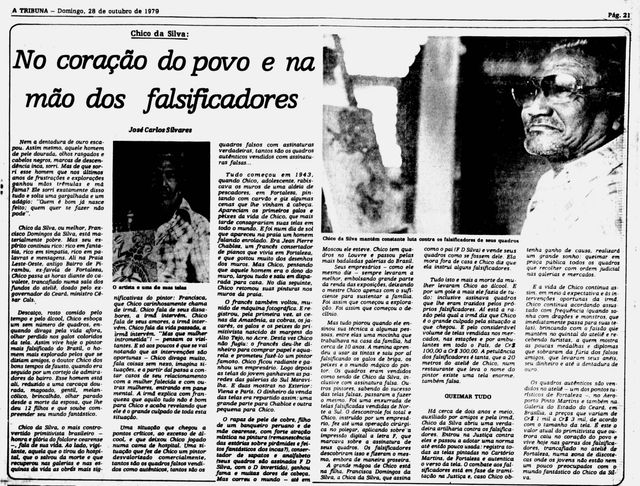
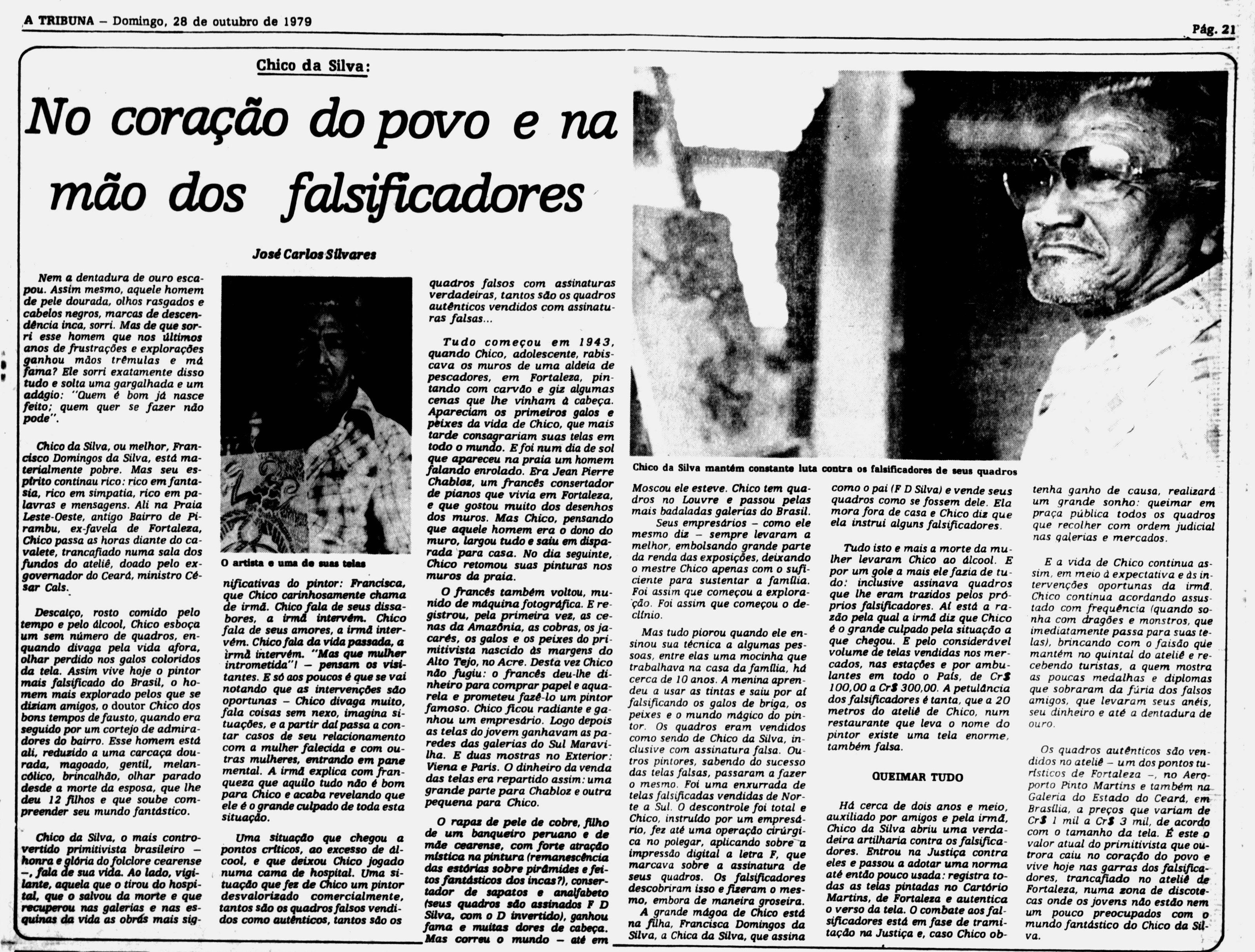
Against the copies, the painter and his middlemen put together an arsenal of marks: the signature with the stroke of the F underlining the name, the thumbprint, pencil lines left on purpose under the paint, live painting sessions in front of buyers and, from 1976, registration at the notary’s office, with the signature certified at the Cartório Martins and a certificate glued or handwritten on the backs of the canvases.929391 No mark settled it, and the sociologist Gerciane Oliveira observes that all these indexes were forged inside the same circuit that produced the works.94 In 1978 a report in the magazine Arte Hoje added the strangest item in the arsenal: a “backwards S” tattooed on his right thumb, with which he stamped “his own works and others’”; a profile the following year spoke of an “F” on the finger, and the divergence never closed.9596
High-resolution viewer. Use the arrow keys to pan, plus and minus to zoom.
In 1979 he was back in the papers accusing forgers, named families that produced a hundred and fifty copies a week, had stones thrown at his roof at night and began denying in public that the School existed: his were only the pictures sold at the studio, at the airport and at a gallery in Brasília.92 The denial reached his own family: in the same round of interviews he pointed to his daughter Chica among the forgers.9296 The courts went as far as appointing experts, among them Roberto Galvão, who would make the workshop the subject of the book he published in 1986.97 The painting factory tells that whole story.
The man
High-resolution viewer. Use the arrow keys to pan, plus and minus to zoom.
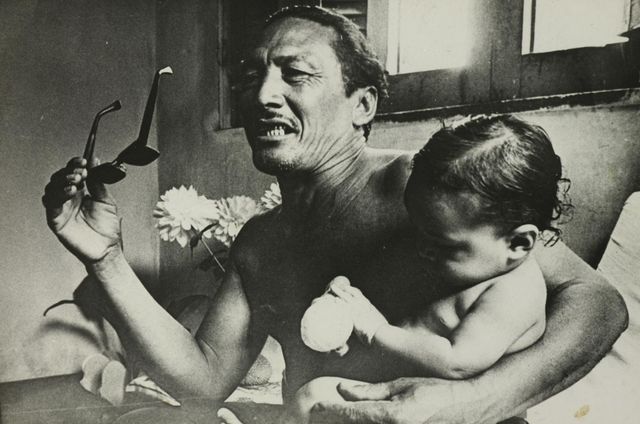
The companion the record names is Maria Dalva da Silva, whom he said he had met in Salvador, daughter of a Bahian woman who sold acarajé in the Pelourinho.498 The press treated her as his wife, but he denied having married, and there is no civil record of the union.99 Dalva died in the mid-1970s, of a cause the press of the day recorded vaguely and divergently, and he pointed to her death as the beginning of his ruin.100101 The number of children he claimed varied with the interview, from a dozen to thirteen, but only two appear in all the records: Chica, who painted in the studio and later signed with her own name, and Carlos Roberto, whom the press of 1976 showed admitting he painted the pictures his father authenticated.102100
The profiles of the day describe him as short and stocky, broad-faced with narrow eyes, dressed in white linen, talkative and quick with a verse.11 He had healthy teeth pulled to show off a set of gold dentures, “always discardable… and pawnable, to help him through the hard moments,” as Estrigas wrote; he said he had bought it in Uruguay, and at night he left it at home, afraid of being robbed.1034 In 1979 a profile in the Santos daily A Tribuna recorded that “not even the gold dentures escaped.”96 He got a car from a commercial group in 1975, the year the university organized a solo show for him, and years later had to sell his telephone to pay the installments.104105 On religion, he answered in his own way: “I am not Catholic or apostolic, or Protestant […] And the soul is for the birds”; even so, in the hospital stay of May 1976, he received the anointing of the sick.4106
High-resolution viewer. Use the arrow keys to pan, plus and minus to zoom.
Last years
At the end of 1974 the public authorities handed him a house and studio on Avenida Leste-Oeste, built by the municipal urbanization company under governor César Cals and mayor Vicente Fialho, and presented without ceremony as a guarantee of provenance: whoever bought there, bought authentic.107108 In the same period Dalva died; the first hospital stay would come soon after, in 1976.100109

High-resolution viewer. Use the arrow keys to pan, plus and minus to zoom.
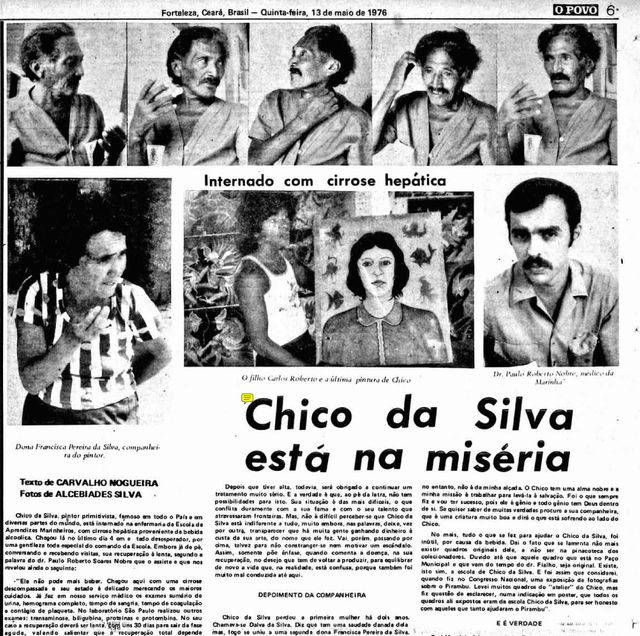
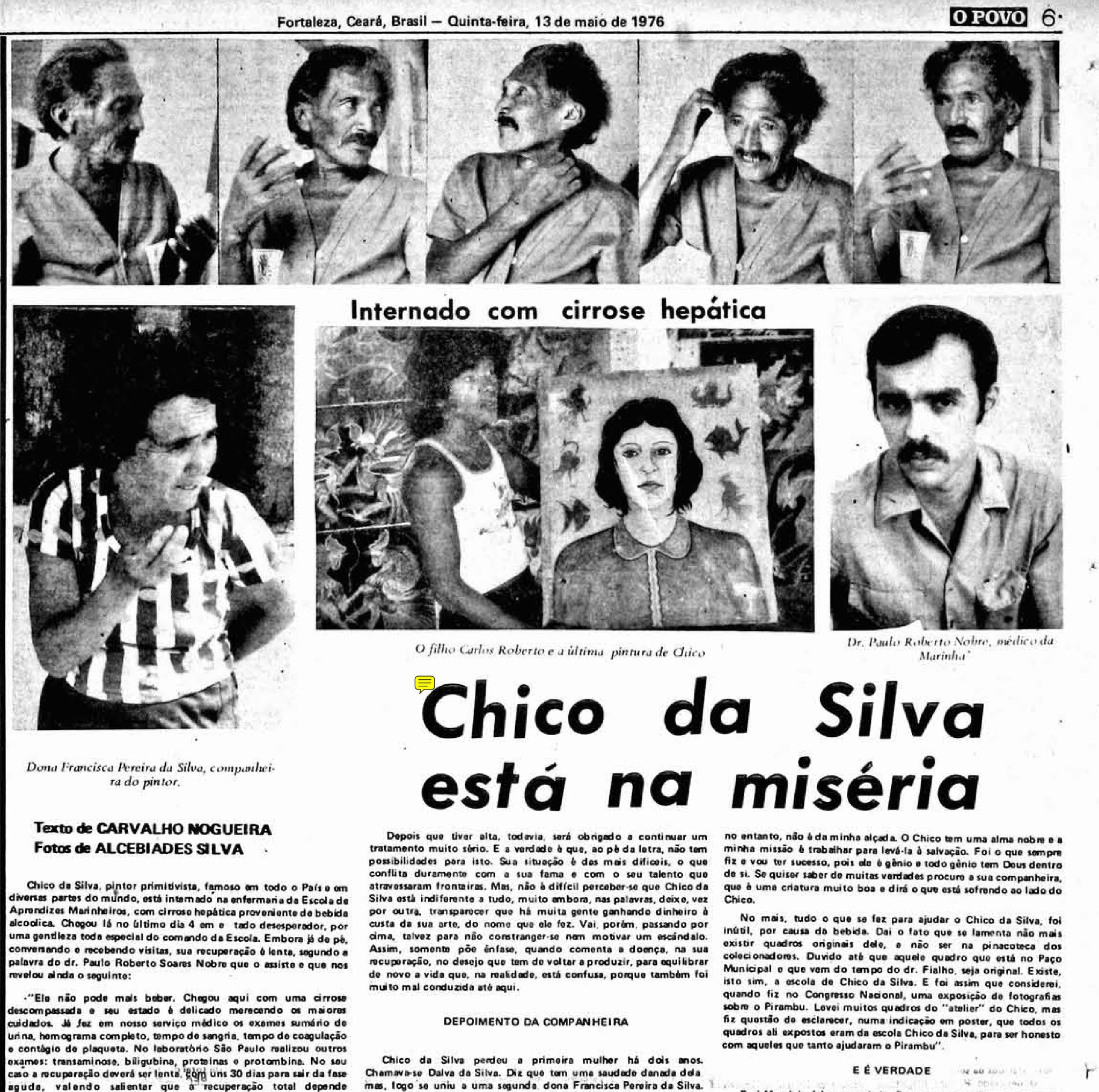
His health gave way for good in May 1976, when he was rushed to the infirmary of the Naval Apprentices School, with cirrhosis aggravated by chronic tuberculosis, and O Povo ran “Chico da Silva está na miséria” (Chico da Silva is destitute); in June he went through intensive care at the university hospital, unconscious.100110 Recovered in August, he relapsed in September, went into delirium and was moved to a nursing home under a diagnosis of alcoholic psychosis, where he spent almost a year painting as occupational therapy.111112 He himself put the ruin down to drink, and the press was merciless in the same key: “since he ‘drowned in the bottle,’ Chico da Silva has stopped painting,” the Estadão wrote.113 It was also the year the city gave him back both affection and demands: the street carnival opened with a float in his honor, the reporter Edmar Morel signed the exposé “A Máfia destruiu Chico da Silva” (The Mafia destroyed Chico da Silva), and artists and intellectuals launched the movement for a foundation to protect his name, with plans to catalog the authentic works by number.114811590
High-resolution viewer. Use the arrow keys to pan, plus and minus to zoom.
Speaking for him in the last decade were the couple Francisca Margarida da Silva and Agostinho Ramires, who said they were the painter’s niece and nephew and took him out of the clinic in August 1977.11695112 Back on the streets, he announced he would not return to Pirambu, named the dealers he said he was free of and summed up: “I have had enough of dealers. Let it all go to hell.”116 In 1978 the house on the Leste-Oeste, renovated by the city, took him back, with twelve pictures in preparation for the I Bienal Latino-Americana de São Paulo; on the facade he had the words “Vou terminar minha vida pintando” (I will end my life painting) written out.117 From the same year is the Anchieta Medal, from the São Paulo city council.118
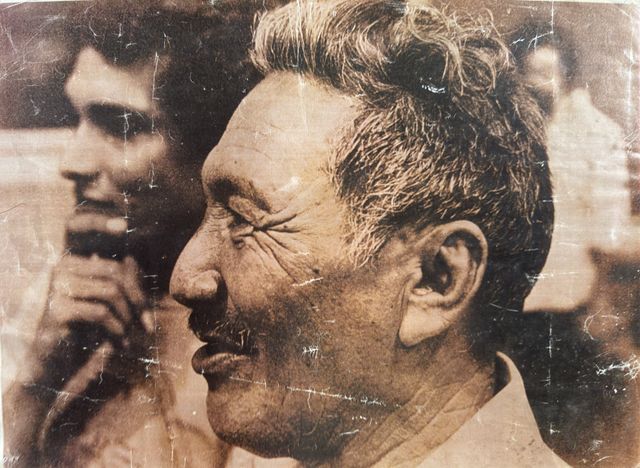
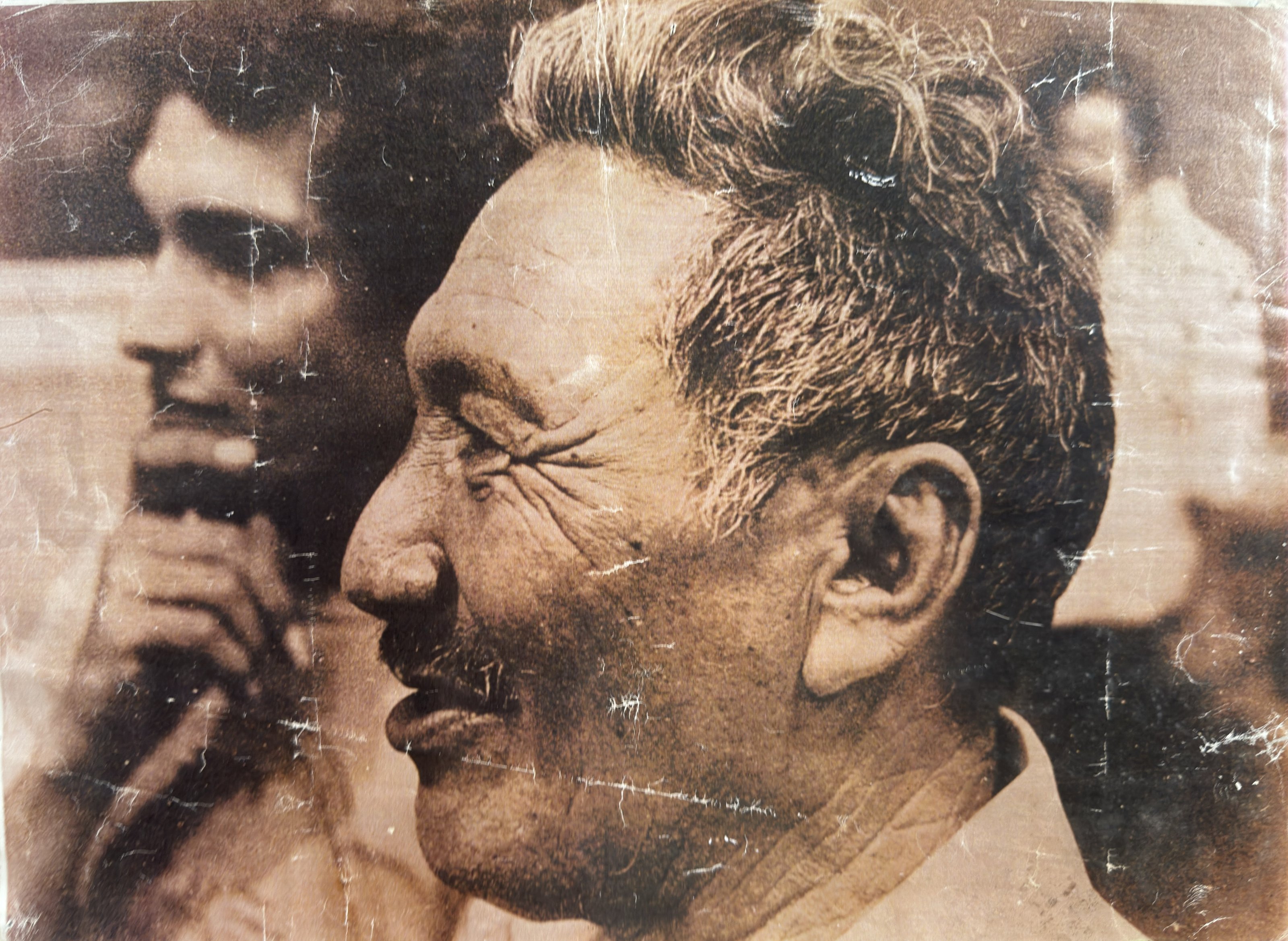
Thromboses in 1979 and in February 1981 paralyzed his right side and left him bedridden for months; left-handed, he went on painting.119 From 1981 he sold from a stall at the Pinto Martins airport, obtained through Luíza Távora, then first lady of the state, about three pictures a week, to pay, he said, for his own burial.12091 In June 1983 Ceará granted him by law a lifetime pension of two minimum salaries; that same year, a reporter who visited found him half-paralyzed, unable to sell a picture for more than fifty thousand cruzeiros, and heard from him that a friend “you only keep while you have health, and money.”121122
High-resolution viewer. Use the arrow keys to pan, plus and minus to zoom.
The honors all came at the end. In 1975 Pedro Jorge de Castro shot in Pirambu the short film Chico da Silva, with photography by Walter Carvalho and music by the Quinteto Armorial, awarded best film on the visual arts at the I Mostra Nacional do Filme Documentário, in Curitiba, in October 1976, and selected in 1978 for the festival of films on art at Asolo, in Italy.123 On March 28, 1984, he received from governor Gonzaga Mota, at the house where he lived, the Medalha da Abolição, the highest decoration of Ceará; the press of those two days recorded the ceremony and the weakened painter thanking those who still recognized him “as an artist.”124125 Acre gave him the Ordem Estrela do Acre, and Chabloz died in Fortaleza in June of that year.126
Death
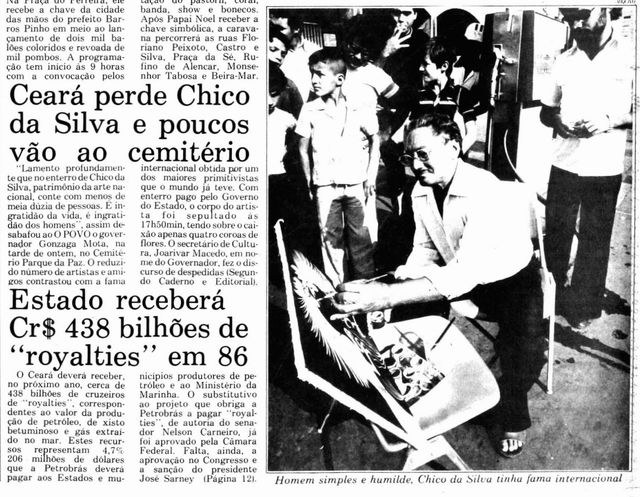
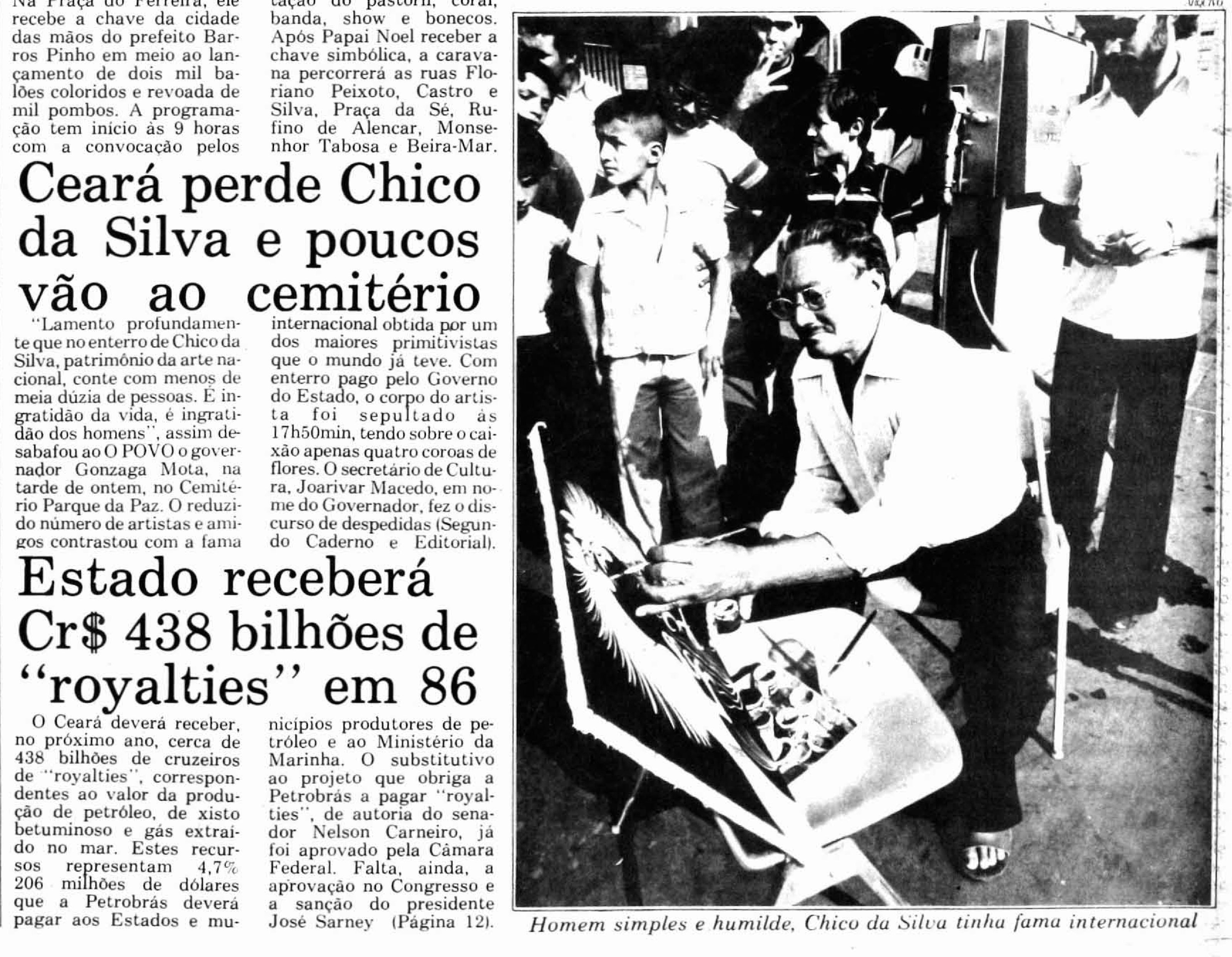
Chico died at 3:20 a.m. on December 6, 1985, at the Policlínica in Fortaleza, of a stroke arising from chronic pulmonary emphysema, four days after being admitted.10 The body was waked at the Casa de Cultura Raimundo Cela and buried that same afternoon, at 5:50 p.m., in the Parque da Paz cemetery, where Chabloz had been buried a year and a half earlier.127128 The burial was paid for by the state, few went to the cemetery, and on the coffin lay four wreaths.127 He died without property: what remained were the house donated by the government and the medal.129 In the O Povo obituary, among the sayings Roberto Galvão gathered, he had left his own epitaph: “While I am alive I have value, and if I die I will have double value.”10
High-resolution viewer. Use the arrow keys to pan, plus and minus to zoom.
Rediscovery
The market had collapsed while he was still alive. In October 1980, the Jornal do Brasil consulted nine Rio galleries and found prices of one to five thousand cruzeiros and general doubt about authorship; in the same report, Chabloz decreed the painter’s “artistic death”: “he became a star, lost his originality, he is a doubtful painter.”130 The 1983 auction yearbook measured the distance in cruzeiros: a Chico da Silva knocked down for twenty thousand, against one million one hundred thousand for an Antônio Bandeira and one million six hundred thousand for an Aldemir Martins.131 A month after his death, a Brasília dealer told the Diário do Nordeste that “Chico da Silva has no market price,” in the market obituary Estrigas transcribed and contested.132 Three years later, though, Chico appeared in Manchete as a forerunner: “street painting, in Brazil, began in Fortaleza.”133
What kept him in circulation over the next two decades was Ceará. In 1989 the Espaço Cultural do Palácio da Abolição staged the retrospective “Do Delírio ao Dilúvio,” with a catalog by Roberto Galvão; in 2001 the state acquired the surviving gouaches of the collection Chabloz had taken to Europe, sixteen by the painter and one by Chica, and showed them in “Chico da Silva vê Chabloz vê Chico da Silva.”13422 For the family the interval changed little: in 1999, when a grandson, Gerardo da Silva, showed painting of his own in Fortaleza, the Diário do Nordeste recorded that they were still asking the government for the painter’s house back, to make a museum of it.135
High-resolution viewer. Use the arrow keys to pan, plus and minus to zoom.
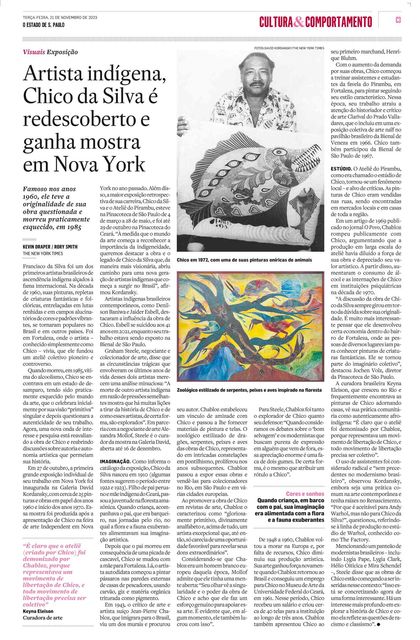
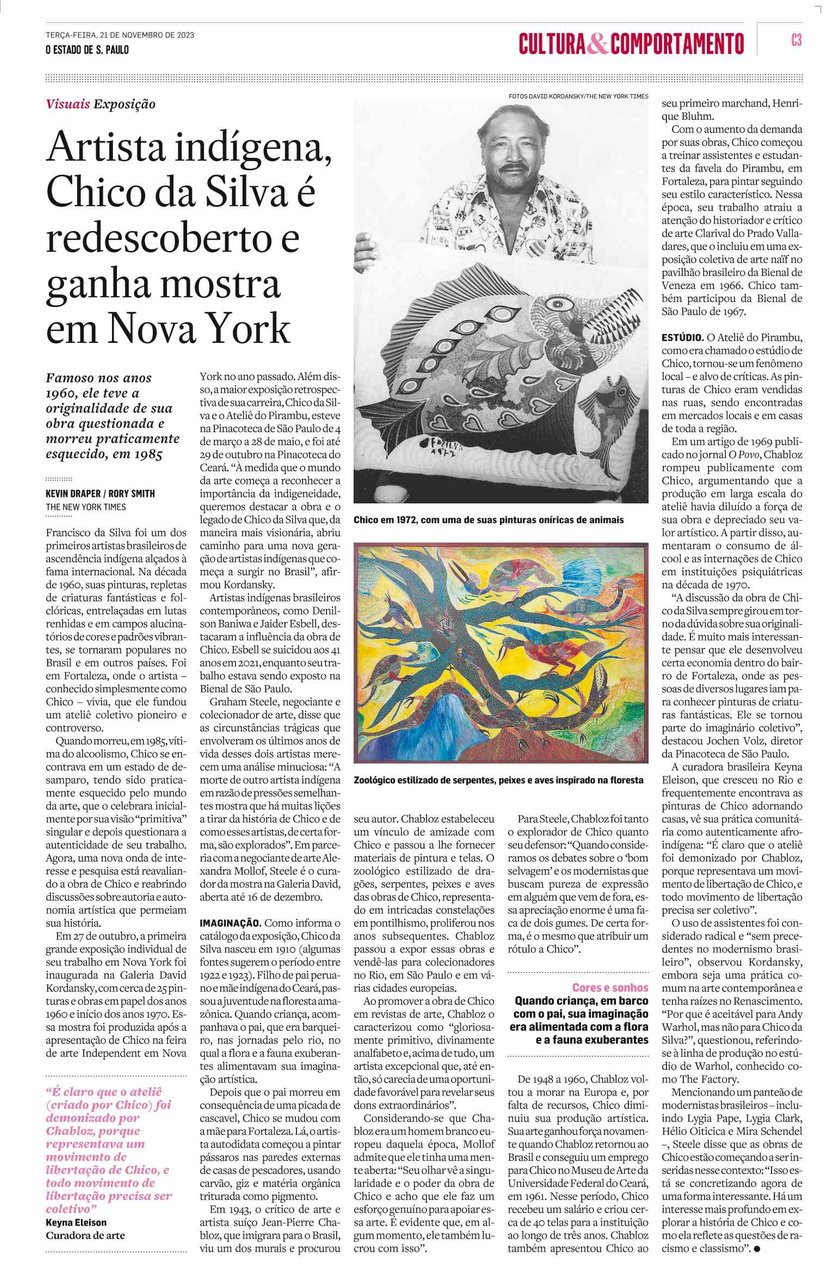
The rediscovery gathered pace in the 2020s. In 2020 the Fortaleza city government decreed the “Chico da Silva Year,” and that year’s Salão de Abril paid him tribute; the same year El Museo del Barrio, in New York, included him in “Popular Painters & Other Visionaries,” the museum’s first virtual exhibition, whose introduction rejects the naïf and primitive labels as pejorative and reductive.136137 In 2023 the retrospective “Chico da Silva e o ateliê do Pirambu” showed 124 works to 88,881 visitors at the Pinacoteca de São Paulo and moved on to the Pinacoteca do Ceará, renamed “Chico da Silva e a Escola do Pirambu,” with 148 works; the David Kordansky Gallery gave him his first New York solo show, and the New York Times piece on the rediscovery, by Hilarie M. Sheets and reprinted in Brazil by the Estadão, described him as one of the first Brazilian artists of Indigenous descent to reach international fame, a declared influence on names like Denilson Baniwa and Jaider Esbell.138139140 Then came the solo show at the BANK gallery in Shanghai (2024, presented as his first in Asia), the dialogue with the canvases of Alvaro Barrington at Mendes Wood DM in São Paulo (2024-2025) and the solo show “Amazônico” at David Kordansky in Los Angeles (2025).141142 In 2026 Nottingham Contemporary opened “And the soul is for the birds,” from June 6 to September 13, his first institutional solo show in Europe; the title translates a line of the painter recorded in 1972: “E a alma é para passarinho.”1434
The auctions followed. In November 2023 Sotheby’s sold in New York Serpente da serra luminosa, a gouache of about 1966 that had hung at the Venice Biennale itself, for US$330,200 over an estimate of US$60,000 to 80,000: the artist’s auction record.144 Phillips has taken nine lots to the block between New York and London, the highest sold at US$76,200; Christie’s sold untitled works in London and in New York; and Bonhams put a 1970s canvas into a Paris sale.145146147
How he painted

High-resolution viewer. Use the arrow keys to pan, plus and minus to zoom.
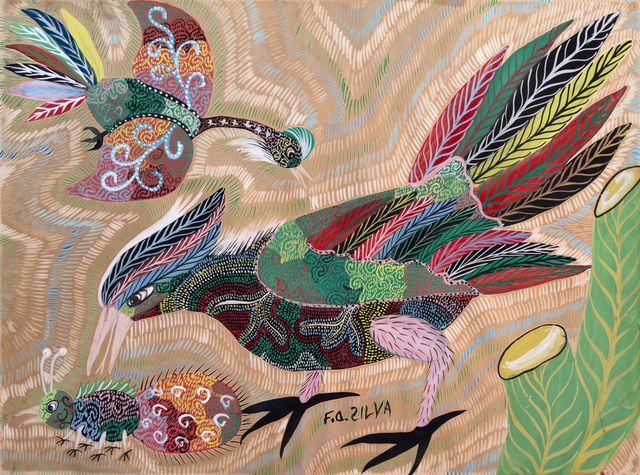
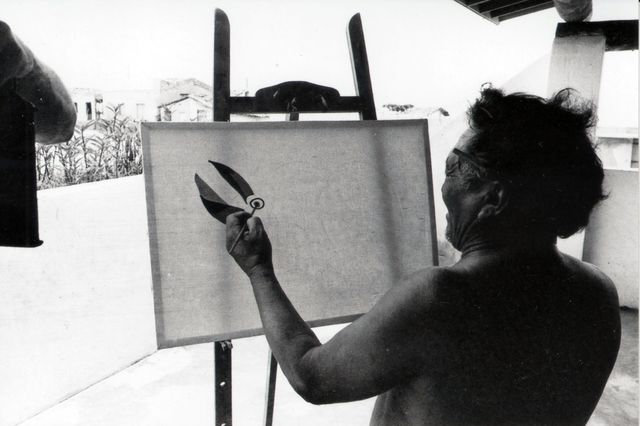
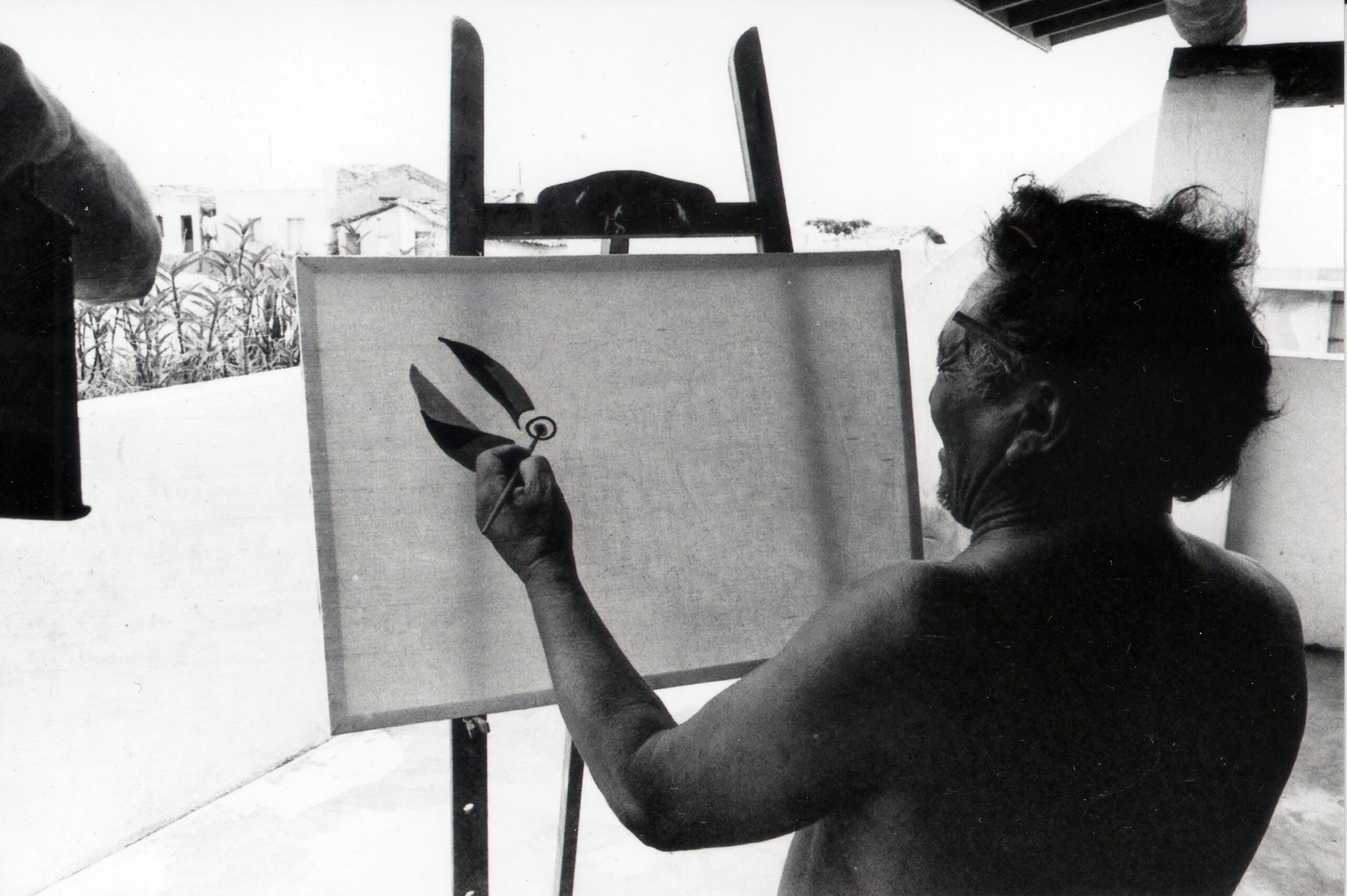
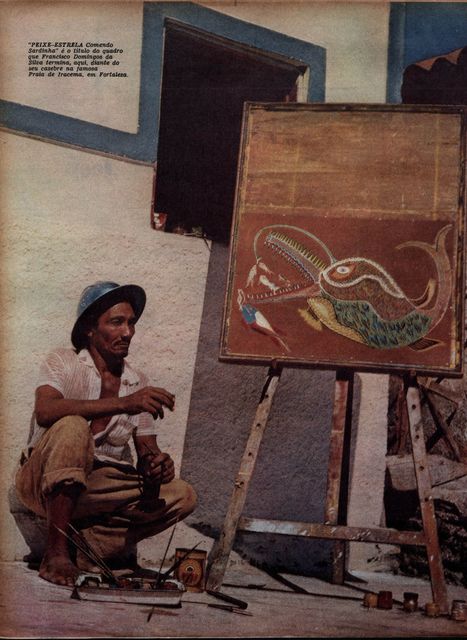
Chico was left-handed and painted fast: “It feels like I have a sewing machine inside my arm,” he told Kawall in 1972.4 He made no preliminary study of composition, and traced the outline of the first figure without minding that it ran past the edge of the paper.148 The card was pinned to the wall with shoemaker’s tacks, and there were always spare drawings waiting for color. The color went on flat, without gradation, and over it came the stippling, which in the studio was called pigmentation, done with the brush loaded with two or three paints at once. The finish was his, with the coat of varnish laid on with a flit gun, which gave the gouache the sheen of oil.148149 “Art is always in my thought; then I stay still and imagine the fish and the birds in motion and begin to work out the colors,” he explained in 1966.14

The support changed three times in forty years: from the wall to bristol board and card, from there to colored duplex board, which spared him painting the ground, and at the end to canvas.150 The catalog records document the sequence of materials: gouache and tempera on card dominate through the 1960s, acrylic appears at the end of the 1960s and oil in 1973.151 Outside the gallery circuit he also painted on kraft paper, cloth, plywood and Eucatex, and, in Claudionor’s memory, “even on clay jars and pots, plates and basins.”152153154 The list of works in the 2005 catalog shows the small and medium format as the rule, and the large panel as the exception.155 Chabloz had refused to teach him oil painting, which he judged too heavy for that work, denied him drawing lessons and talked him out of painting the human figure; he thought the logical end of that work would have been fresco.156
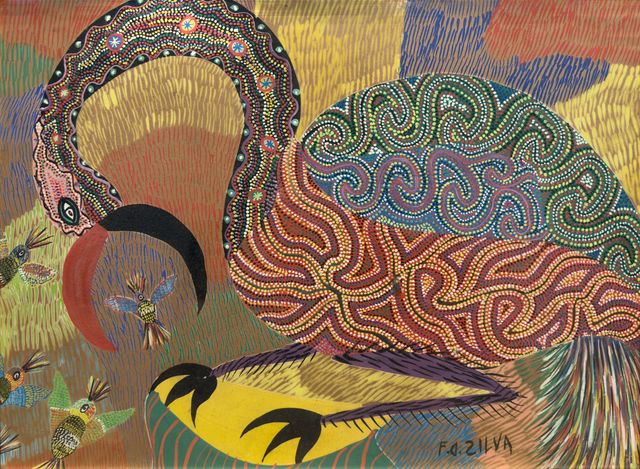
He signed “F. D. Silva” and stamped beside it the print of his thumb, wetted in the same paint as the picture; the repertoire of marks grew with the forgers, from the thumbprint to the notarized signature and the particularized “F,” in a chronology his son Roberto detailed to the press two days after his father’s death.58 The letters come out irregular in the surviving examples: on a 1983 canvas in the João Cunha Collection, the name is written at lower center with the D and the S reversed.
The bestiary
The repertoire settled early and changed little in forty years. What Chabloz saw on the walls in 1943 was already nearly all of it: “elegant birds, monstrous fish and fantastic ships,” in the description Silberstein collected from the current version of the discovery.20 Thirty years later the painter listed the same cast, with little new: “Dragons, fish, birds, roosters, the monstrous snakes, the butterflies and a few pond jaçanãs,” he said in 1973.157 The colors are raw and flat, without gradation and without any suggestion of depth, and the surface leaves no empty space.148


The reading of the work as memory of an Amazonian childhood followed it from the first review on, and the painter refused it: “These worlds I paint are not recollections of when I was a boy […] this is called imagination, occult sciences, astronomy.”158 On the origin of the monsters, three explanations of his coexist in the record: dreams (“I try to reproduce with the brushes the dreams I have when I sleep,” 1966), the cinema (“I think they must exist, yes. Because I have seen them in many films,” 1976) and drink (“They are hallucinations that come with the cachaça,” the same year).3159 For Gerciane Oliveira, the simplification of the repertoire from the 1960s on has a material and economic cause: the motifs were pared down into standardized models precisely so that many hands could execute them.160
Two motifs came later, at a buyer’s request. The cockfight came from Aldemir Martins’s roosters, adapted by Ivan de Assis from the cover of a school notebook, with the base drawing also claimed by Claudionor; the dragons came off the alligator printed on the can of Querosene Jacaré, an appropriation the sources credit to Claudionor.64161 The black ground, which became a mark of the studio’s production, was adopted “because of its success in sales,” the 2024 catalog records.162
What the critics saw
The international reception came out of Chabloz, who later disowned it. In the Cahiers d’Art essay, in 1952, he held that the painter had covered alone, in a few years, the whole cycle of Western painting; for the wall drawings he had seen in 1943 he kept the description of “a style of great originality, poetic power of evocation and distinctly archaic,” and summed up their author in a single sentence: “Sympathetically nomadic, gloriously primitive, divinely illiterate, the Indian Francisco Silva was above all a marvelous artist.”326163 In 1969 he broke with him publicly, and in 1980 declared that his former discovery had become a star and a “doubtful painter.”85130 Against the primitivist current, Valladares stated in 1966 that Chico had nothing of the primary about him and was a professional with almost thirty years of the trade.50

Out of the break came a yardstick for the market: Chabloz held that only the gouaches of the two stays of the 1940s stood up to any imitation, and Lélia Coelho Frota, in 1977, wrote that “the first phase of Chico da Silva’s work” was the one that fit “with the greatest adequacy” the roster of authentic primitives, treating the late case as “the most paroxysmal” example of a primitive undone by the market.19164 The comparison with the great workshops of history appeared in the heat of the Maria Augusta case, from José Roberto Teixeira Leite; Walmir Ayala, in 1976, proposed the division into three periods, the authentic work, the school that painted under the master’s assistance and those who painted without his knowledge, and argued that, with disciples painting “as well as or better than him,” verifying authenticity no longer mattered.86165
In 1977, side by side in the same issue of the Ceará university’s Revista de Ciências Sociais, two studies of the case came out. Frota proposed the category of liminality to describe the painter’s position between two worlds; Silberstein turned the accusation around: he read the case through the key of colonialism, explained Chabloz’s attack by the nostalgia for a lost paradise, and held that the critics had reduced the work to Amazonian exoticism, erasing what in it was northeastern and urban.164166 The measure from inside the field, decades later, would be formulated by the sociology of Gerciane Oliveira as a grid of four statuses, from the picture entirely by the master to the picture made and signed by the helper.167
The label changed again in the 2020s. Curators began presenting him as an Indigenous artist, and Jochen Volz, general director of the Pinacoteca de São Paulo, wrote in the 2023 catalog that the work had for decades been superficially labeled naïf, regional and decorative.168 Oliveira herself, who follows the reclassification, treats it as a decision of curatorship, not of biography: she notes that the Indigenous key pushes into the background his place in Pirambu, an urban and peripheral territory, and the cinema and advertising references that are in the work.169 Jaider Esbell, who pointed to his influence, referred to him as a mestizo artist.170 In his lifetime, the painter himself dodged every label: “I do not know who I am. I do not know if I am from the moon or from the earth. The painter Jean Pierre Chabloz is the one who said I am a primitivist painter. I say nothing.”171 The debate is in Primitive, naïve, Indigenous.
Selected exhibitions
In his lifetime
- 1944: III Salão Cearense de Pintura and II Salão de Abril, Fortaleza23
- 1945: group show of Ceará artists, Galeria Askanasy, Rio de Janeiro24
- 1949: Salle Beauregard, Geneva31
- 1951: Palácio Foz, Lisbon31
- 1952: Galerie Pour L’Art, Lausanne (solo)31
- 1955-1956: “Le Brésil”, Musée d’ethnographie de Neuchâtel33
- 1961: first solo show, Diários Associados, Fortaleza41
- 1963: Galeria Relevo, Rio de Janeiro (solo)45
- 1965: solo shows in Salvador, São Paulo and Rio de Janeiro; “Oito Pintores Ingênuos Brasileiros”, Galerie Jacques Massol, Paris46
- 1966: 33rd Venice Biennale, honorable mention; Petite Galerie, Rio de Janeiro; “Brasil Incomum”, Maison Janson, Paris; “Primitivos Brasileiros”, Madrid485054
- 1967: IX Bienal de São Paulo; group show of primitives, Galeria Copacabana Palace, Rio de Janeiro5455
- 1968: Galerie M. Bénézit, Paris (solo, twenty gouaches)172
- 1970: Galeria Portal, São Paulo (solo, 35 canvases)11
- 1972: SUDENE gallery, Recife (some forty pictures)173
- 1973: Pinacoteca do Estado do Amazonas, Manaus (63 works); show at the Chamber of Deputies, Brasília (December)174175
- 1974: “Escola de Chico da Silva”, Anexo II of the Chamber of Deputies, Brasília (fifty pictures by the School, September 16 to 20)176
- 1978: I Bienal Latino-Americana de São Paulo; special room at the XXVIII Salão de Abril, Fortaleza; Galeria Art Nueva, São Paulo; EMCETUR, Fortaleza117177178179
- 1979: Casa do Ceará, Brasília92
Posthumous
- 1989: retrospective “Do Delírio ao Dilúvio”, Espaço Cultural do Palácio da Abolição, Fortaleza134
- 2001: “Chico da Silva vê Chabloz vê Chico da Silva”, Centro Cultural da Abolição, Fortaleza22
- 2005: “Chico da Silva em Três Dimensões”, Centro Cultural Banco do Nordeste, Fortaleza180
- 2012: “Histoires de voir”, Fondation Cartier, Paris181
- 2020: “Popular Painters & Other Visionaries”, El Museo del Barrio, New York137
- 2021-2022: “Composições para tempos insurgentes”, Museu de Arte Moderna do Rio de Janeiro182
- 2022: Gomide&Co, São Paulo (solo); “Conexão Sagrada. Visão Global”, Museu de Arte Sacra, São Paulo; Independent Art Fair, New York181169183
- 2023: “Chico da Silva e o ateliê do Pirambu”, Pinacoteca de São Paulo; “Chico da Silva e a Escola do Pirambu”, Pinacoteca do Ceará; David Kordansky Gallery, New York (solo); “Cores que Cantam, Dragões que se Devoram”, Museu da Imagem e do Som do Ceará, Fortaleza138140184
- 2024: “Chico da Silva: Amazônian Legend”, BANK, Shanghai (solo); “Escola do Pirambu: Um Legado de Chico da Silva”, Centro Cultural Belchior, Fortaleza14159
- 2024-2025: “Alvaro Barrington & Chico da Silva”, Mendes Wood DM, São Paulo142
- 2025: “Amazônico”, David Kordansky Gallery, Los Angeles (solo)142
- 2026: “And the soul is for the birds”, Nottingham Contemporary, United Kingdom (solo)143
Museums and public collections
Works by Chico da Silva are in public collections such as:
- Museu de Arte da Universidade Federal do Ceará (MAUC), Fortaleza, which holds 78 works of his, forty of them donated in 2014185
- Collection of the Government of the State of Ceará (gouaches from the former Chabloz collection), Fortaleza22
- Pinacoteca do Ceará, Fortaleza138
- Museu de Arte de São Paulo (MASP)181
- Museu de Arte Moderna de São Paulo (MAM-SP)181
- Museu de Arte Contemporânea da Universidade de São Paulo (MAC USP)181
- Museu de Arte Moderna do Rio de Janeiro (MAM Rio)181
- Museu de Arte do Rio (MAR)181
- Museu de Arte de Belém (MABE)181
- Câmara dos Deputados, Brasília, where an untitled 1973 canvas, acrylic, 200 by 248 centimeters, hangs in the Lanchonete do Salão Verde186
- Rollins Museum of Art, Winter Park, Florida142
- Musée d’Art Naïf et d’Arts Singuliers (MANAS), Laval, France142
- La Coopérative-Musée Cérès Franco, Montolieu, France142
- Musée d’ethnographie de Neuchâtel, Switzerland34
- Centre Pompidou, Paris, whose graphic art department holds Luta de dragões (1960) and A luta pela vida (c. 1964), donated in 2023154
Tate, in London, has held since 2022 O Grande Pássaro (The Great Bird), a 1966 gouache on plywood of 1.5 by 2.2 meters, on long-term loan from the Tate Americas Foundation.153
The João Cunha Collection
In the João Cunha Collection, works by Chico da Silva and the Pirambu School are gathered and documented, from the early gouaches on paper to the large acrylics of the Fortaleza years, some under a dual attribution, such as “Chico da Silva por Babá”.

This is the biography of the painter Chico da Silva. The samba composer of the same name is another person.
Bibliography
Books, catalogs and studies cited in the notes; the period press is cited in full in each note.
- Chico da Silva em três dimensões. Exhibition catalog, Centro Cultural Banco do Nordeste. Fortaleza, 2005.
- Chico da Silva vê Chabloz vê Chico da Silva. Exhibition catalog, Centro Cultural da Abolição. Fortaleza: Secretaria da Cultura do Estado do Ceará, 2001.
- Cores que cantam, dragões que se devoram: o universo de Chico da Silva. Exhibition catalog. Fortaleza: Edições MIS, 2024.
- Estrigas [Nilo de Brito Firmeza]. A saga do pintor Francisco Domingos da Silva. Fortaleza: Tukano, 1988.
- Estrigas [Nilo de Brito Firmeza]. Arte Ceará: Mário Baratta: o líder da renovação. Fortaleza: Museu do Ceará; Secretaria da Cultura do Estado do Ceará, 2004.
- Freitas, Thierry de, Bitú Cassundé and Flávia Muluc, eds. Chico da Silva e o ateliê do Pirambu. São Paulo: Pinacoteca de São Paulo, 2023.
- Le Brésil: arts primitifs indigène, afro-brésilien, populaire; arts modernes. Exhibition catalog. Neuchâtel: Musée d’ethnographie, 1955.
- Frota, Lélia Coelho. “Liminaridade da obra de Francisco da Silva face aos modos ‘normais’ da criação artística no Brasil”. Revista de Ciências Sociais 8, no. 1-2 (1977): 205-217.
- Galvão, Roberto. Chico da Silva e a Escola do Pirambu. Fortaleza: Secretaria de Cultura e Desporto do Ceará, 1986.
- Galvão, Roberto. Chico da Silva: do delírio ao dilúvio. Exhibition catalog. Fortaleza: Costa Gráfica, 1989.
- Louzada, Júlio. Artes plásticas: seu mercado, seus leilões. São Paulo: J. Louzada, 1984.
- Machado, Gilberto Andrade. “Calidoscópio: história do ensino de artes plásticas em Fortaleza”. PhD thesis, Universidade Federal do Ceará, 2008.
- Muluc, Flávia, ed. A Escola do Pirambu: um legado de Chico da Silva. Fortaleza: Gráfica LCR, 2024.
- Oliveira, Gerciane Maria da Costa. Chico da Silva: a emergência de um talento artístico. Fortaleza: EdUECE, 2023.
- Oliveira, Gerciane Maria da Costa. “É ou não é um quadro Chico da Silva?”. PhD thesis, Universidade Federal do Ceará, 2015.
- Oliveira, Gerciane Maria da Costa. “Autenticidade, produção coletiva e mercado de pintura: o caso do artista naïf Chico da Silva”. Revista de Ciências Sociais 48, no. 1 (2017): 69-88.
- Oliveira, Gerciane Maria da Costa. “Entre lógicas distintas de comercialização de pintura: o mercado restrito e ampliado de quadros naïfs ‘Chico da Silva’ em Fortaleza”. NAVA 2, no. 2 (2017): 440-453.
- Oliveira, Gerciane Maria da Costa. “Quando um estilo artístico individual se torna uma maneira de pintar? O caso do artista naïf Chico da Silva”. Crítica Cultural 12, no. 2 (2017): 305-313.
- Oliveira, Gerciane Maria da Costa. “Chico da Silva, o pioneiro da arte indígena? A dinâmica de reclassificação do artista acreano em recentes exposições”. MODOS: Revista de História da Arte 8, no. 2 (2024): 706-726.
- Silberstein, David A. “Colonialismo e cultura popular: o caso de Chico da Silva”. Revista de Ciências Sociais 8, no. 1-2 (1977): 219-232.
Notes
Notes
-
Estrigas, A saga do pintor Francisco Domingos da Silva (Fortaleza: Tukano, 1988); Gerciane Maria da Costa Oliveira, Chico da Silva: a emergência de um talento artístico (Fortaleza: EdUECE, 2023); the Tejo river and the present-day municipality of Marechal Thaumaturgo, chronology of Chico da Silva vê Chabloz vê Chico da Silva (2001). ↩
-
Eduardo Campos, “Francisco da Silva e seu Mundo Fantástico”, O Cruzeiro, September 28, 1963, pp. 110-111, Hemeroteca Digital Brasileira. The feature gives the birth as March 16, 1922, and names the parents. ↩ ↩2 ↩3 ↩4
-
“Pintor diz que sua arte é explorada por dono de galeria”, Correio da Manhã, June 12, 1966, p. 13, Hemeroteca Digital Brasileira. ↩ ↩2 ↩3 ↩4
-
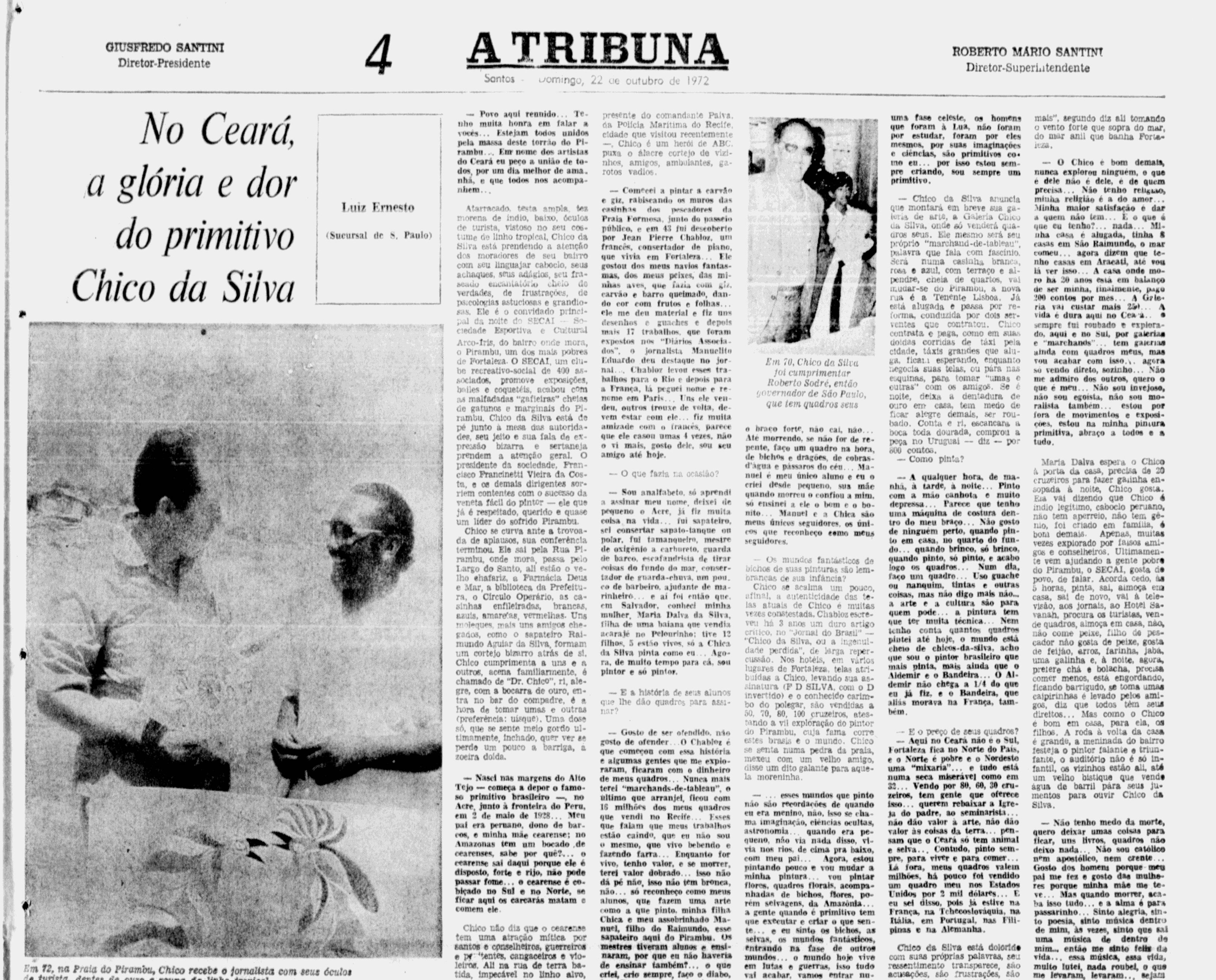
Luiz Ernesto [Machado Kawall], “No Ceará, a glória e a dor do primitivo Chico da Silva”, A Tribuna (Santos), October 22, 1972, p. 4, Hemeroteca Digital Brasileira; text reproduced on the Arnaldo Chieus blog, January 21, 2015. ↩ ↩2 ↩3 ↩4 ↩5 ↩6 ↩7 ↩8
-
Estrigas, A saga do pintor, which argues for 1922 or 1923 and attributes the 1910 to an error in Roberto Pontual’s Dicionário. ↩
-
Luiz Carlos Antero, “Um ‘índio’ entre os mercadores”, Movimento, no. 85, February 14, 1977, p. 16, Hemeroteca Digital Brasileira. ↩ ↩2 ↩3 ↩4 ↩5 ↩6
-
Oliveira, A emergência de um talento artístico, on the father of the same name and of Kampa origin, the mother Minervina Félix de Lima and the father’s death in Quixadá. ↩ ↩2 ↩3
-
Edmar Morel, “A Máfia destruiu Chico da Silva”, O Povo, June 1, 1976, p. 5. ↩ ↩2 ↩3
-
Estrigas, A saga do pintor, on the signature learned at the university museum. ↩
-
“Chico da Silva deixa no tempo a criatividade da arte ingênua”, O Povo, December 7, 1985, Segundo Caderno, p. 1, with the box “Frases de Chico da Silva”, by Roberto Galvão. ↩ ↩2 ↩3 ↩4 ↩5
-
“Chico da Silva”, O Estado de S. Paulo, November 5, 1970, p. 17, Acervo Estadão. ↩ ↩2 ↩3
-
Hilton Oliveira, “Êles Fazem a Vida da Cidade: O Chico ‘Chic’”, Unitário, April 1967, Portal da História do Ceará. ↩ ↩2 ↩3 ↩4
-
Roberto Galvão, Chico da Silva e a Escola do Pirambu (Fortaleza: Secretaria de Cultura e Desporto do Ceará, 1986); the 1937 marker is the consensus of the sources, repeated by the painter himself. ↩
-
“A pintura onírica de Chico da Silva”, Correio Braziliense, 1974 (ed. 04399), Caderno 2, Hemeroteca Digital Brasileira, bib 028274; the article reproduces statements taken by José Maria Iglesias in 1966. ↩ ↩2
-
“4 séculos de arte industrializada”, Jornal do Brasil, June 25, 1969, Caderno B, p. 25, Hemeroteca Digital Brasileira. ↩ ↩2 ↩3
-
Estrigas, A saga do pintor. ↩
-
“Quadros de Chico da Silva desaparecem em São Paulo”, O Povo, April 3, 1978, p. 14. ↩
-
Estrigas, A saga do pintor; the detail appears only in that book. ↩
-
Jean-Pierre Chabloz, “Francisco Silva ou a ingenuidade perdida”, Jornal do Brasil, August 23, 1969, Caderno B, p. 25, Hemeroteca Digital Brasileira. ↩ ↩2 ↩3 ↩4
-
David A. Silberstein, “Colonialismo e cultura popular: o caso de Chico da Silva”, Revista de Ciências Sociais 8, no. 1-2 (1977), p. 222. ↩ ↩2
-
Oliveira, A emergência de um talento artístico, on the commission method; the list of materials and the advance payment, Chico da Silva vê Chabloz vê Chico da Silva (2001). ↩
-
Chico da Silva vê Chabloz vê Chico da Silva, exhibition catalog (Fortaleza: Secretaria da Cultura do Estado do Ceará, 2001), presentation text: the collection had twenty works from the 1943-45 and 1947-48 phases; sixteen, plus one by Chica da Silva, returned to Ceará in 2001. ↩ ↩2 ↩3 ↩4 ↩5
-
Galvão, Chico da Silva e a Escola do Pirambu; on Chabloz’s organization of the III Salão, “O culto da Arte”, O Nordeste, January 24, 1944, p. 14, Portal da História do Ceará. ↩ ↩2
-
Mário Baratta, “Exposição Cearense”, O Estado (Fortaleza), July 1, 1945, and “A Velha Arte Moderna”, July 8, 1945; reproduced in Estrigas, Arte Ceará: Mário Baratta (Fortaleza: Museu do Ceará, 2004), pp. 54-57, digitized in the ICAA archive (record 1111388). ↩
-
Silberstein, “Colonialismo e cultura popular”, pp. 224-225. ↩ ↩2 ↩3
-
“Letras & Artes”, O Nordeste, August 13, 1948, p. 1, Portal da História do Ceará. ↩
-
“Société mutuelle artistique (Salle Beauregard)”, Journal de Genève, October 5, 1949, p. 5, Le Temps Archives; the “fall of 1949” context in Oliveira, A emergência de um talento artístico, p. 64. Estrigas dates the Salle Beauregard show to 1950. ↩
-
Oliveira, A emergência de um talento artístico, on Geneva (1949), the Palácio Foz (1951) and the Jeanne Bucher withdrawal; the 1952 date for the Galerie Pour L’Art follows the recent institutional records of the galleries that represent the work today. ↩ ↩2 ↩3 ↩4
-
Jean-Pierre Chabloz, “Un indien brésilien réinvente la peinture”, Cahiers d’Art (Paris), December 1952, according to Estrigas, A saga do pintor, and Oliveira, A emergência de um talento artístico. ↩ ↩2
-
Le Brésil: arts primitifs indigène, afro-brésilien, populaire; arts modernes, exhibition catalog (Neuchâtel: Musée d’ethnographie, 1955); Galvão, Chico da Silva e a Escola do Pirambu, p. 13. Estrigas dates the show to 1959. ↩ ↩2
-
Galvão, Chico da Silva e a Escola do Pirambu; the Neuchâtel presence is also recalled in Walter Sotomayor, “Chico da Silva”, Correio Braziliense, October 28, 1976. ↩ ↩2
-
Galvão, Chico da Silva e a Escola do Pirambu, pp. 17 and 77. ↩
-
Estrigas, A saga do pintor, p. 56, citing the Jornal da Tarde of June 24, 1969. ↩
-
“Chico da Silva (desta vez o autêntico) expõe no Rio”, O Globo, November 26, 1977, p. 33. ↩
-
Galvão, Chico da Silva e a Escola do Pirambu; also Chico da Silva em três dimensões, exhibition catalog (Fortaleza, 2005). ↩
-
“Que é que há? (No Ceará)”, O Nordeste, March 24, 1960, p. 1, Portal da História do Ceará. ↩
-
Galvão, Chico da Silva e a Escola do Pirambu; the count of some forty gouaches in the core comes from the reference books, with variation up to 43. ↩ ↩2
-
Estrigas, A saga do pintor, which details the solo show of April 10, 1961, and the museum’s inaugural group show of June 25. ↩ ↩2 ↩3
-
[Profile of Chico Santeiro], Jornal do Brasil, July 27, 1962, Caderno B, p. 13, Hemeroteca Digital Brasileira. ↩
-
Gerciane Maria da Costa Oliveira, “É ou não é um quadro Chico da Silva?” (PhD thesis, Universidade Federal do Ceará, 2015), pp. 149-150. ↩ ↩2
-
Estrigas, A saga do pintor, p. 43 (“cantor de músicas eruditas”, and the Di Caura snack bar); Silberstein, “Colonialismo e cultura popular”, p. 225. ↩
-
Galvão, Chico da Silva e a Escola do Pirambu, on the Galeria Relevo and the presentations by Chabloz and Aldemir Martins. ↩ ↩2
-
Galvão, Chico da Silva e a Escola do Pirambu; the Paris group show by Jean Boghici is dated 1965 by Galvão, with a divergent record of 1949 in another chronology; the 1965 São Paulo solo show (Selearte), Estrigas, A saga do pintor, p. 96. ↩ ↩2
-
Galvão, Chico da Silva e a Escola do Pirambu. ↩
-
Roberto Galvão, Chico da Silva: do delírio ao dilúvio, exhibition catalog (Fortaleza: Costa Gráfica, 1989); the January 1966 date for the selection, Estrigas, A saga do pintor. ↩ ↩2
-
Letter from Clarival do Prado Valladares to Haroldo Juaçaba, September 23, 1966, transcribed in Galvão, Do delírio ao dilúvio. ↩ ↩2 ↩3
-
Edyla Mangabeira Unger, “Artes Plásticas: O Que Vai Acontecer”, O Globo, June 9, 1966, p. 6, which transcribes Valladares’s presentation. ↩ ↩2 ↩3
-
Francisco Domingos da Silva, ASACdati database, Archivio Storico delle Arti Contemporanee, La Biennale di Venezia, records of the four works from the 33rd Biennale (1966), accessed August 12, 2026. ↩
-
Estrigas, A saga do pintor, which records the honorable mention as the only prize of the painter’s life, and notes that the prize sought for him ended up with Artur Luiz Piza. ↩
-
“Outras & Outras”, Correio do Ceará, July 10, 1974, p. 11, Portal da História do Ceará. ↩
-
Galvão, Chico da Silva e a Escola do Pirambu; Galvão, Do delírio ao dilúvio. ↩ ↩2 ↩3
-
“Primitivos Estréiam Hoje em Copacabana”, O Globo, June 22, 1967, p. 6. ↩ ↩2
-
Galvão, Chico da Silva e a Escola do Pirambu; Oliveira, “É ou não é um quadro Chico da Silva?”. ↩
-
“Os Pintores do Pirambu”, Correio do Ceará, March 16, 1977, p. 4, Portal da História do Ceará. ↩ ↩2 ↩3
-
Sâmara Paula, “Chico da Silva terá galeria retrospectiva”, Diário do Nordeste, December 8, 1985. ↩ ↩2
-
Muluc, A Escola do Pirambu, published in the wake of the Centro Cultural Belchior exhibition of the same name (2024). ↩ ↩2
-
Galvão, Chico da Silva e a Escola do Pirambu, on the division of labor and the staged apprenticeship. ↩ ↩2
-
“Chico da Silva e a Escola do Pirambu: Memória e Imaginário”, episode 1, interview with Garcia (José dos Santos Gomes), video, July 8, 2024. ↩
-
“Os Chicos da Silva da cidade mostram a cara”, O Povo, April 3, 1977, p. 12, apud Gilberto Andrade Machado, “Calidoscópio” (PhD thesis, UFC, 2008), pp. 58-59; Chica’s statement also in “Os Pintores do Pirambu”, Correio do Ceará, March 16, 1977. ↩
-
Statement by Gilberto Lee, in Flávia Muluc, ed., A Escola do Pirambu: um legado de Chico da Silva (Fortaleza: Gráfica LCR, 2024), p. 20. ↩
-
Oliveira, “É ou não é um quadro Chico da Silva?”, pp. 72, 160 and 193, with the map of motifs by disciple. ↩ ↩2
-
Galvão, Chico da Silva e a Escola do Pirambu. ↩
-
Galvão, Chico da Silva e a Escola do Pirambu. ↩
-
Galvão, Chico da Silva e a Escola do Pirambu. ↩
-
Carvalho Nogueira, “Ainda a Babel de Chico da Silva”, O Povo, June 7, 1976, p. 4. ↩
-
Graça Magalhães, “Pirambu: todos pintam ‘Chico da Silva’”, Tribuna do Ceará, May 10, 1975, p. 1, apud Gerciane Maria da Costa Oliveira, “Quando um estilo artístico individual se torna uma maneira de pintar?”, Crítica Cultural 12, no. 2 (2017): 307. ↩
-
Oliveira, “É ou não é um quadro Chico da Silva?”, pp. 149-150; Machado, “Calidoscópio”, pp. 57-58. ↩ ↩2
-
Frederico Morais, “No Ceará tem gravura, rabiscos e arte conceitual”, O Globo, March 30, 1977, p. 36. ↩
-
Galvão, Chico da Silva e a Escola do Pirambu; Galvão, Do delírio ao dilúvio. ↩
-
David Silberstein, “Homens Trabalhando”, in Muluc, A Escola do Pirambu, p. 26. ↩
-
Muluc, A Escola do Pirambu, pp. 72-75; “Painel artístico da Escola do Pirambu será da UFC após acordo”, O Povo, May 31, 2023, opovo.com.br; “UFC assina acordo no MPF”, mauc.ufc.br. ↩
-
TVDD #arte, interview with Garcia (José dos Santos Gomes), video, February 19, 2026. ↩ ↩2
-
Claudionor Nogueira, “João Clôud, O Leão Pantera”, autobiographical text, in Muluc, A Escola do Pirambu, pp. 58-71. ↩ ↩2 ↩3
-
Muluc, A Escola do Pirambu, which names Garcia as the only one of the core still living and dedicates the volume to Chico, Babá, Claudionor, Chica, Ivan and Garcia. ↩
-
“Da Escola do Pirambu: Garcia se inspira no imaginário ancestral para produzir arte”, O Povo, April 27, 2021, mais.opovo.com.br. ↩
-
“Silva diz que Relêvo está vendendo no Rio imitações das suas telas primitivas”, Jornal do Brasil, February 8, 1966, p. 10, Hemeroteca Digital Brasileira. ↩
-
Oliveira, “É ou não é um quadro Chico da Silva?”, p. 170. ↩
-
Gazeta de Notícias (Fortaleza), June 12, 1969, according to Galvão, Chico da Silva e a Escola do Pirambu, and Estrigas, A saga do pintor. ↩
-
“O teste dos peixes”, O Globo, June 18, 1969, p. 1, and “Teste aprova menina que acusa o pintor”, p. 7. ↩ ↩2
-
“As acusações sôbre Chico Silva são muitas; mas há quem o defenda…”, O Cruzeiro, August 7, 1969, pp. 62-63, Hemeroteca Digital Brasileira. ↩
-
“Chico Silva se defende”, O Estado de S. Paulo, June 18, 1969, p. 12, Acervo Estadão. ↩
-
“Chabloz descreve: ascensão e queda de Chico da Silva”, O Povo, June 30, 1969, p. 5; Galvão, Chico da Silva e a Escola do Pirambu, p. 20, dates the statements to June 18 and records the nickname “Fábrica de Quadros Chico da Silva Limitada”. ↩ ↩2
-
José Roberto Teixeira Leite, “Subitamente cessaram os comentários sobre o caso Chico da Silva”, O Globo, July 21, 1969, p. 5. ↩ ↩2
-
“Fortaleza, o verão de um ano inteiro”, Jornal do Brasil, Caderno de Turismo, February 24, 1972. ↩
-
“Ceará defende pintor”, Jornal do Brasil, August 1, 1974, p. 22; “Quadros de Chico da Silva são imitados”, Diário de Pernambuco, August 1, 1974, p. 9. ↩
-
Walmir Ayala, “A febre Chico da Silva”, Jornal do Brasil, February 17, 1974, Caderno B, p. 6. ↩
-
“Artistas lutam para preservar nome e obra de Chico da Silva”, O Estado de S. Paulo, February 19, 1977, p. 9, Acervo Estadão. ↩ ↩2
-
“Chico da Silva: ‘check-up’ e venda de obras em São Paulo”, O Globo, February 25, 1984, p. 25. ↩ ↩2 ↩3
-
“Chico da Silva volta a acusar falsificadores”, Correio do Ceará, June 28, 1979, pp. 1 and 13, Portal da História do Ceará. ↩ ↩2 ↩3 ↩4
-
“Chico na Casa do Ceará”, Correio Braziliense, May 8, 1979, p. 26, Hemeroteca Digital Brasileira, bib 028274; also Carlos Figueiredo, “Do Aeroporto”, Correio do Ceará, April 9, 1979. ↩
-
Oliveira, “É ou não é um quadro Chico da Silva?”, pp. 185-191; Oliveira, “Autenticidade, produção coletiva e mercado de pintura”, Revista de Ciências Sociais 48, no. 1 (2017): 69-88. ↩
-
André Papi, “Um índio reinventa a pintura”, Arte Hoje 1, no. 9, March 1978, pp. 28-30. ↩ ↩2
-
José Carlos Silvares, “No coração do povo e na mão dos falsificadores”, A Tribuna (Santos), October 28, 1979, p. 21, Hemeroteca Digital Brasileira. ↩ ↩2 ↩3
-
Galvão, Do delírio ao dilúvio; Oliveira, “É ou não é um quadro Chico da Silva?”. ↩
-
Galvão, Chico da Silva e a Escola do Pirambu, p. 69, section of the painter’s statements. ↩
-
Galvão, Chico da Silva e a Escola do Pirambu, p. 70, with the line “Nunca casei porque sempre tive medo de ser traído” (I never married because I was always afraid of being betrayed). ↩
-
“Chico da Silva está na miséria”, O Povo, May 13, 1976, p. 6. ↩ ↩2 ↩3 ↩4
-
“A verdadeira situação de Chico da Silva”, João Alberto column, Diário de Pernambuco, November 9, 1974, Segundo Caderno, p. 5. ↩
-
Galvão, Chico da Silva e a Escola do Pirambu, p. 70, with the painter’s statements about his children. ↩
-
Estrigas, A saga do pintor. ↩
-
Galvão, Chico da Silva e a Escola do Pirambu; Estrigas, A saga do pintor. ↩
-
Galvão, Chico da Silva e a Escola do Pirambu, p. 27. ↩
-
Galvão, Chico da Silva e a Escola do Pirambu, p. 24: admitted on May 4, 1976, he received the anointing of the sick the next day. ↩
-
“Fortaleza dá casa a Chico Silva”, Jornal do Brasil, December 30, 1974, p. 18. ↩
-
Luciano Diógenes, “Casa para Chico Silva”, Correio do Ceará, August 13, 1974, p. 7; “Casa de Chico Silva no ‘Ano da Cultura’”, Correio do Ceará, January 2, 1975, p. 5. ↩
-
Galvão, Do delírio ao dilúvio. ↩
-
“Chico da Silva está inconsciente”, O Estado de S. Paulo, June 20, 1976, p. 17. ↩
-
“Recuperado, Chico volta aos quadros”, O Estado de S. Paulo, August 14, 1976, p. 12. ↩
-
Galvão, Do delírio ao dilúvio; Estrigas, A saga do pintor. ↩ ↩2
-
“Chico morre pouco a pouco, esquecido”, O Estado de S. Paulo, May 14, 1976, p. 9, Acervo Estadão. ↩
-
“Uma instituição para zelar o nome Chico da Silva”, O Povo, December 19, 1976, Caderno B, p. 4. ↩
-
“Estou vendendo saúde e não vou voltar mais ao Pirambu”, O Povo, August 31, 1977, p. 12. ↩ ↩2
-
“Chico da Silva volta ao seu ‘atelier’ na Av. Leste-Oeste”, O Povo, August 13, 1978, p. 9. ↩ ↩2
-
Galvão, Chico da Silva e a Escola do Pirambu; Estrigas, A saga do pintor; the year swings between 1977 and 1978 in the chronologies, and 1978 is the date of most sources. ↩
-
Galvão, Do delírio ao dilúvio. ↩
-
Galvão, Do delírio ao dilúvio; the pace of sales and the burial, chronology of Chico da Silva vê Chabloz vê Chico da Silva (2001). ↩
-
State law no. 10.807, Diário Oficial do Ceará, June 28, 1983; Galvão, Do delírio ao dilúvio. ↩
-
“Doente e abandonado pelos amigos, Chico da Silva só deseja forças para pintar”, O Povo, October 13, 1983, Caderno Z, p. 13. ↩
-
“Curtas premiados no Paraná”, O Estado de S. Paulo, October 21, 1976, p. 10; official letter 48/76-GT of the I Mostra Nacional do Filme Documentário, Curitiba, November 8, 1976; catalog of the 6º Festival Internazionale del Film sull’Arte, Asolo, 1978. ↩
-
“Sofrimento e miséria na arte, mas com medalhas em vida”, O Povo, March 28, 1984, Caderno Z, p. 15. ↩
-
“Chico da Silva é condecorado em Fortaleza”, O Estado de S. Paulo, March 29, 1984, p. 24. ↩
-
The Ordem Estrela do Acre, chronology of Chico da Silva vê Chabloz vê Chico da Silva (2001); Chabloz’s death on June 10, 1984, Estrigas, A saga do pintor. ↩
-
“Ceará perde Chico da Silva e poucos vão ao cemitério”, O Povo, December 7, 1985, p. 1. ↩ ↩2
-
Machado, “Calidoscópio”, p. 59. ↩
-
Rodolfo Espínola, “Morre o primitivista Chico da Silva”, O Estado de S. Paulo, December 7, 1985, p. 18, Acervo Estadão. ↩
-
Egídio Serpa, “Suíço decreta a morte artística de Chico da Silva”, Jornal do Brasil, October 24, 1980, p. 26, Hemeroteca Digital Brasileira. ↩ ↩2
-
Júlio Louzada, Artes plásticas: seu mercado, seus leilões (São Paulo: J. Louzada, 1984), apud Oliveira, “Entre lógicas distintas de comercialização de pintura”, 449. ↩
-
“Chico da Silva não tem cotação”, Diário do Nordeste, January 3, 1986, transcribed and contested in Estrigas, A saga do pintor, pp. 76-77, with the reply of the critic Inês Fiuza. ↩
-
“A arte mural pinta como o grande grito artístico do fim do milênio”, Manchete, no. 1878 (1988), p. 74, Hemeroteca Digital Brasileira. ↩
-
Galvão, Do delírio ao dilúvio, catalog of the 1989 retrospective. ↩ ↩2
-
“‘Primitivos’ resgata memória de Chico da Silva”, Diário do Nordeste, February 2, 1999, Caderno 3, p. 5. ↩
-
Muluc, A Escola do Pirambu, on the 2020 municipal decree and the tribute of the 71º Salão de Abril. ↩
-
“Popular Painters & Other Visionaries”, El Museo del Barrio, New York, August 6 to November 8, 2020, curated by Rodrigo Moura; official announcement with the rejection of the labels (accessed August 12, 2026). ↩ ↩2
-
“Chico da Silva e o ateliê do Pirambu”, Pinacoteca de São Paulo, March 4 to May 28, 2023, curated by Thierry de Freitas; attendance and work count of the Ceará show in “Pinacoteca do Ceará abre maior exposição já realizada sobre o artista”, Pinacoteca do Ceará, July 7, 2023 (accessed August 12, 2026). ↩ ↩2 ↩3
-
Hilarie M. Sheets, “A Visionary Brazilian Artist Is Rediscovered”, The New York Times, October 19, 2023. ↩
-
“Artista indígena, Chico da Silva é redescoberto e ganha mostra em Nova York”, O Estado de S. Paulo, November 21, 2023, p. C3, Acervo Estadão; translation of the New York Times article. ↩ ↩2
-
“Chico da Silva: Amazônian Legend”, BANK, Shanghai, March 23 to May 16, 2024, curated by Simon Watson; the opening text presents it as the painter’s first solo show in Asia (accessed August 12, 2026). ↩ ↩2
-
David Kordansky Gallery, institutional CV of Chico da Silva (New York/Los Angeles, 2026). ↩ ↩2 ↩3 ↩4 ↩5 ↩6
-
“Chico da Silva: And the soul is for the birds”, Nottingham Contemporary, June 6 to September 13, 2026, curated by Salma Tuqan and Niall Ó Faircheallaigh (accessed August 12, 2026). ↩ ↩2
-
“Serpente da serra luminosa”, lot 243, Modern Day Auction, Sotheby’s, New York, November 14, 2023; result in the official report of the November sales (accessed August 12, 2026). The lot record lists the work in the “XXXIII Biennale Internazionale d’Arte Venezia”, 1966. ↩
-
Chico da Silva: auction results, Phillips; the highest price is “Bichos e Passaros” (1965), New Now, New York, March 2024 (accessed August 12, 2026). ↩
-
Chico da Silva lots at Christie’s: untitled, London, GBP 35,280 and untitled, New York, USD 32,760 (accessed August 12, 2026). ↩
-
“Sans titre” (1971), Post-War & Contemporary Art, Bonhams, Paris, September 2025 (accessed August 12, 2026). ↩
-
Galvão, Chico da Silva e a Escola do Pirambu, on the working process observed at the studio; the outline running past the edge of the paper, Estrigas, A saga do pintor, p. 79. ↩ ↩2 ↩3
-
TVDD #arte, interview with Maria Augusta do Carmo Moreira, video, June 11, 2026. ↩
-
Oliveira, “É ou não é um quadro Chico da Silva?”, on the sequence of card, duplex board and canvas; also Estrigas, A saga do pintor, p. 79. ↩
-
Oliveira, A emergência de um talento artístico, list of works with some eighty technical records. ↩
-
Claudionor Nogueira, “João Clôud, O Leão Pantera”, in Muluc, A Escola do Pirambu, pp. 58-71, with the list of supports “papel madeira, duplex, telas, tecido” (kraft paper, duplex board, canvases, cloth); the plywood and the Eucatex are in the Tate and Pompidou records. ↩
-
“The Great Bird” (1966), Tate; the L04628 reference indicates a work on loan (accessed August 12, 2026). ↩ ↩2
-
Collection records of the Centre Pompidou, Cabinet d’art graphique, Musée national d’art moderne: Luta de dragões (1960), inv. AM 2024-287, and A luta pela vida (c. 1964), inv. AM 2024-288, Galatea donation, 2023. ↩ ↩2
-
List of works in Chico da Silva em três dimensões, exhibition catalog (Fortaleza, 2005), pp. 70-71; the generalization is ours, drawn from the list. ↩
-
Oliveira, A emergência de um talento artístico: Chabloz forbade oil, denied drawing lessons and discouraged the human figure; the fresco as the logical end comes from Chabloz’s statement in Chico da Silva vê Chabloz vê Chico da Silva (2001), recalled also by Estrigas. ↩
-
Galvão, Chico da Silva e a Escola do Pirambu, compendium of the painter’s statements; the line is from an interview with the Jornal da Imaculada, May 5, 1973. ↩
-
Oliveira, A emergência de um talento artístico, p. 19. ↩
-
Galvão, Chico da Silva e a Escola do Pirambu, p. 73, annex of statements: the cinema line to the magazine Ele & Ela (1976) and the hallucinations line to Edmar Morel, “A Máfia destruiu Chico da Silva”, O Povo, June 1, 1976, p. 5. ↩
-
Oliveira, “Autenticidade, produção coletiva e mercado de pintura”, 69-88; Oliveira, “É ou não é um quadro Chico da Silva?”. ↩
-
Muluc, A Escola do Pirambu, pp. 6 and 34. ↩
-
Muluc, A Escola do Pirambu, p. 6, presentation text; Silberstein, in the same volume, ties the black ground to the market phase. ↩
-
Jean-Pierre Chabloz, “Um índio reinventa a Pintura”, in Chico da Silva vê Chabloz vê Chico da Silva, exhibition catalog (Fortaleza, 2001). ↩
-
Lélia Coelho Frota, “Liminaridade da obra de Francisco da Silva face aos modos ‘normais’ da criação artística no Brasil”, Revista de Ciências Sociais 8, no. 1-2 (1977): 205-217. ↩ ↩2
-
Walmir Ayala, “Chico da Silva”, Diário de Notícias (Rio de Janeiro), 1976, p. 11, Hemeroteca Digital Brasileira. ↩
-
Silberstein, “Colonialismo e cultura popular”, 219-232. ↩
-
Oliveira, “É ou não é um quadro Chico da Silva?”, p. 193. ↩
-
Jochen Volz, presentation text, in Thierry de Freitas, Bitú Cassundé and Flávia Muluc, eds., Chico da Silva e o ateliê do Pirambu (São Paulo: Pinacoteca de São Paulo, 2023), 9; transcribed in Oliveira, “Chico da Silva, o pioneiro da arte indígena?”, 717-718. ↩
-
Gerciane Maria da Costa Oliveira, “Chico da Silva, o pioneiro da arte indígena?”, MODOS: Revista de História da Arte 8, no. 2 (2024): 706-726, DOI 10.20396/modos.v8i2.8675001. ↩ ↩2
-
Jaider Esbell, “Arte indígena contemporânea e o grande mundo”, the artist’s website, June 14, 2018, apud Oliveira, “Chico da Silva, o pioneiro da arte indígena?”, 723. ↩
-
Afrânio Coutinho, “Chico da Silva”, O Povo, December 7, 1985, p. 6. ↩
-
José Rangel, “Chico Silva mostra passaros em Paris”, O Povo, February 29, 1968, p. 5. ↩
-
“Chico da Silva abrirá hoje exposição com 40 quadros”, Diário de Pernambuco, September 1, 1972, p. 7. ↩
-
“Primitivo expõe 63 trabalhos: AM”, Correio Braziliense, February 24, 1973, Caderno de Integração. ↩
-
Estrigas, A saga do pintor, exhibition listing (“Câmara Federal sob a Presidência do Dep. Flávio Marcílio, 27/12/1973”); Ari Cunha, “Mesa da Cidade” column, Correio Braziliense, October 25, 1973, p. 15. ↩
-
“Escola de Chico da Silva expõe quadros”, Correio Braziliense, September 19, 1974, ed. 04589, p. 9, Hemeroteca Digital Brasileira. ↩
-
Estrigas, A saga do pintor, p. 95. ↩
-
“Do pop ao primitivismo nas 12 exposições desta semana”, O Estado de S. Paulo, March 14, 1978, p. 25. ↩
-
Flávio, “Destaques Sociais”, Correio do Ceará, December 19, 1978, p. 11. ↩
-
Chico da Silva em três dimensões, exhibition catalog (Fortaleza, 2005). ↩
-
Gomide&Co, institutional CV of Chico da Silva (São Paulo, 2026). ↩ ↩2 ↩3 ↩4 ↩5 ↩6 ↩7 ↩8
-
“Composições para tempos insurgentes: Francisco da Silva”, Museu de Arte Moderna do Rio de Janeiro, 2021-2022. ↩
-
“Chico da Silva: Brazil’s forgotten visionary”, Independent Art Fair, New York, 2022; Oliveira, “Chico da Silva, o pioneiro da arte indígena?”, 716. ↩
-
Cores que cantam, dragões que se devoram: o universo de Chico da Silva, exhibition catalog (Fortaleza: Edições MIS, 2024). ↩
-
“Coleção Chico da Silva”, Museu de Arte da UFC: 78 works, with the donation of forty gouaches by Vera Bezerra in 2014 (accessed August 12, 2026). ↩
-
Chico da Silva, “Sem título” (1973), collection record of the Museu da Câmara dos Deputados (accessed August 12, 2026). ↩


