The Pirambu School
Inside Chico da Silva's Pirambu studio in Fortaleza: the five young painters of the Escola do Pirambu, their collective method, and the double attribution.
In 1963 Chico da Silva left the Museu de Arte da Universidade Federal do Ceará, where he had painted since 1961, and went back to working at home in Pirambu, a seaside neighbourhood of Fortaleza settled largely by families displaced by drought. Buyers followed him there. Henrique Bluhm became his first dealer around that time, and orders soon outran what one hand could deliver. Roberto Galvão, in his 1985 monograph Chico da Silva e a Escola do Pirambu, dates the first helpers to late 1963 or early 1964: boys from the surrounding streets who had been watching the painter work. Out of that household arrangement grew the group Fortaleza came to call the Escola do Pirambu, the Pirambu School, which the Brazilian press would turn into a national argument over authorship before the decade ended. The painter’s own route, from Acre in the western Amazon to this house by the sea, is told in his biography.
The original five
The 2024 volume organized by curator Flávia Muluc for the exhibition “Escola do Pirambu: Um legado de Chico da Silva” names an original core of five: Babá (Sebastião Lima da Silva), Claudionor (José Claudionor Nogueira), Garcia (José dos Santos Gomes), Ivan (Ivan José de Assis) and Chica (Francisca Silva), the painter’s daughter. Each came through a different door. Galvão records that Babá’s father wanted him in the family shoe workshop; the boy preferred watching Chico paint, and was the first to put a brush to the work. Garcia lived on the next street, backyard to backyard with the painter. In the 2024 documentary Memória e Imaginário he remembers coming home from school at around five and going straight to watch the drawings, until Chico asked whether he wanted to learn. Ivan was drawing creatures from Hollywood’s Greek mythology films when Chico invited him in (Galvão, 1985). Claudionor led the drawing, and the 2024 volume records his own account that he was already supplying sketches for Chico to fill during the museum years. The circle did not stop at five. Galvão counts nearly three dozen disciples at the peak, working in the house or in workshops that split off from it.
How a painting crossed the room
Work was divided by stage. Galvão, quoted in the 2024 volume, describes the routine: Ivan and Claudionor drew; Garcia, Babá and Chica filled the fields of colour; Chico kept the finish for himself, the corrections, the varnish applied with a flit pump, the signature and the sale. The material was gouache on light card pinned to the wall with shoemaker’s tacks; canvas entered later, through the parallel workshops, because it sold for more (Galvão, 1985). Garcia, in the 2024 documentary, lays out the apprenticeship in the same order: first filling inside the drawn line, then the stippling the group called pigmentação, and only later animals of one’s own. Everyone was paid for the stage executed, the same volume records, and Gilberto Brito, a restorer who spent part of his youth in the studio, remembers the helpers in the same documentary series as boys of twelve, fifteen, twenty, and adds that Chico repainted whatever fell short of his standard. Motifs entered through the group as much as through the founder. Garcia, interviewed by Muluc in January 2023, says the fighting cocks answered client requests and took Aldemir Martins’s roosters as a reference, with Ivan drawing the first one from the cover of a school notebook; the dragons came off the label of Querosene Jacaré, a kerosene sold with an alligator on the can; the black grounds stayed in the repertoire because they sold well.

A question kept open
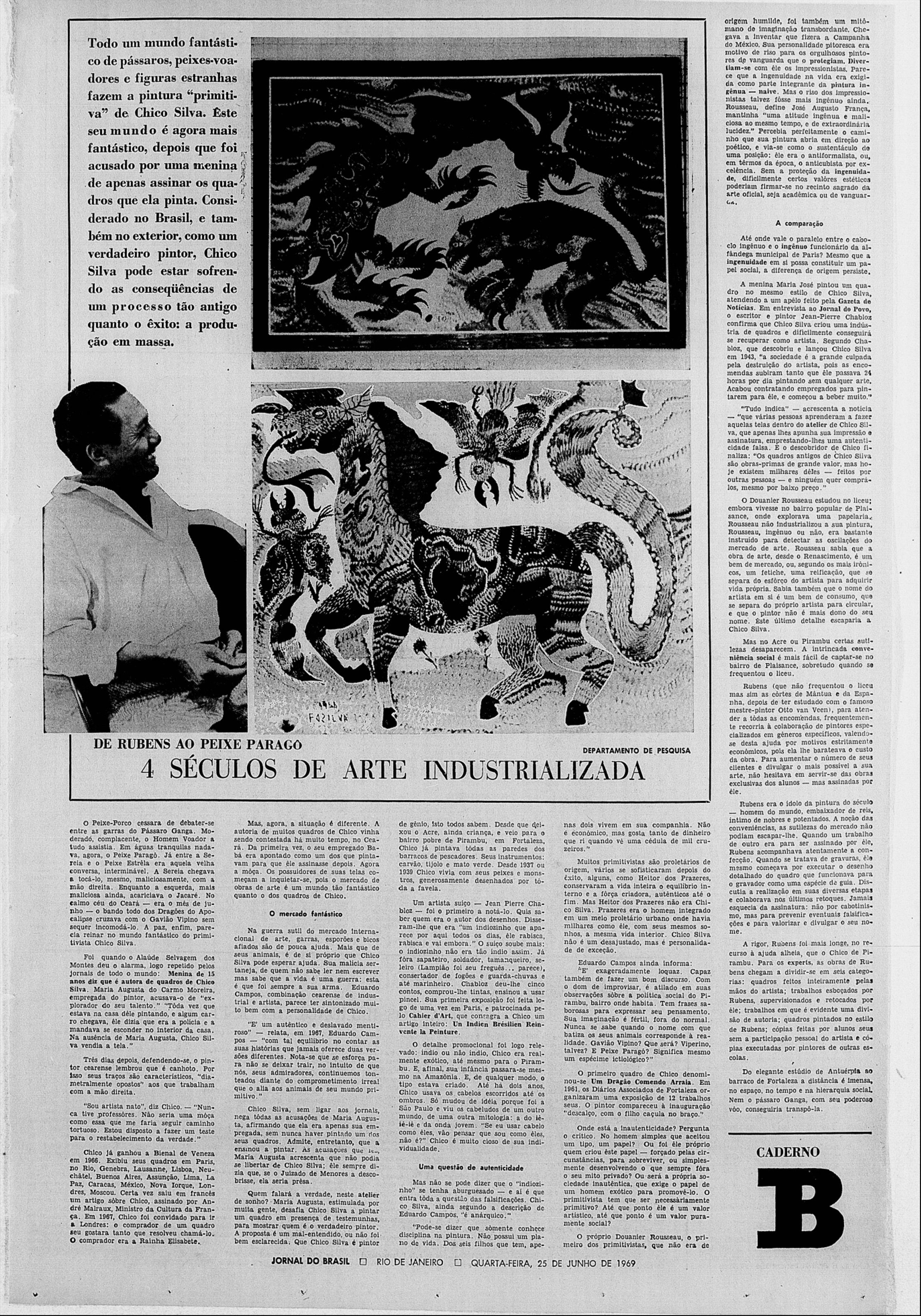
The collective mode became public through scandal. The doctoral thesis of Gerciane Oliveira (2015) places the first one in 1966, at the Petite Galerie in Rio de Janeiro, with the painter’s wife Dalva denouncing canvases by other hands; Galvão adds that Chico went to the police and recognized as authentic works Babá had painted. In June 1969 the Fortaleza daily Gazeta de Notícias published the case of Maria Augusta, a fifteen-year-old girl who said she had spent five years painting for Chico to sign, and O Cruzeiro carried her testimony across Brazil that year. On 25 June 1969 the Jornal do Brasil reproduced Jean Pierre Chabloz, the Swiss artist who had launched Chico in the 1940s, saying the painter had created an “indústria de quadros”, an industry of paintings. Oliveira’s thesis maps the four categories the market has used ever since: paintings made entirely by Silva, made with assistance, made by the assistants and signed by Silva, made and signed by the assistants. A reply took shape in 1977. With the study group founded that year by Hélio Rôla, Gilberto Brito and David Silberstein, the five exhibited as “Pintores do Pirambu” at the III Exanor and painted the collective panel Homens Trabalhando at the Salão de Abril, with Chico leaving the hospital to join them (Galvão, 1985). Garcia’s answer went on record in the 2024 documentary: everything painted in Chico’s house, under his eye, his instruction and his signature, is Chico. Galvão’s estimate, cited in the 2024 volume, is that some 90 percent of the works in circulation came out of the school. Where one hand ends and another begins stays an open question, and this catalogue documents the practice rather than settling it.
The double name in this collection
The João Cunha Collection keeps both hands visible. Canvases painted by Babá enter the catalogue under the double attribution “Chico da Silva por Babá”, Chico da Silva by Babá: the founder’s universe, the disciple’s hand. The three paintings linked to this article are acrylics Babá painted in 2005 and 2006, two decades after Chico died in Fortaleza on 6 December 1985; the commission behind them is the subject of the article on the Instituto Oboé. Garcia, the only member of the core still alive, paints to this day in Ceará, and his route has its own chapter in Garcia, the last disciple. Oliveira’s thesis registers a following generation as well: Gerardo da Silva, a grandson of the painter, took first place at the 2004 Bienal Naïf. Set beside the gouaches of the 1960s, Babá’s late fish and dragons carry the same naïve art repertoire four decades on. The school outlived its founder.

