Venice, 1966
Chico da Silva's honourable mention at the 33rd Venice Biennale (1966), the press, and the imaginary journeys of the Pirambu School painter of Fortaleza.
On 9 June 1966, the arts column of Rio’s O Globo announced a show of watercolours by Francisco Domingos da Silva at the Petite Galerie and reminded readers that the critic Clarival do Prado Valadares had chosen him as one of three painters to represent Brazil at that year’s Venice Biennale, the 33rd. Three days later, Correio da Manhã printed a long interview. The painter about to be shown in Venice lived, by his own description, in a shack on Pirambu beach in Fortaleza, in the neighbourhood that gave the Escola do Pirambu its name, with the sea advancing on it, and he complained that dealers bought his pictures for very little and resold them at high prices. He also told the reporter he reckoned he was born in 1928. The date moves from one account to another; what the documents support is set out in his biography.
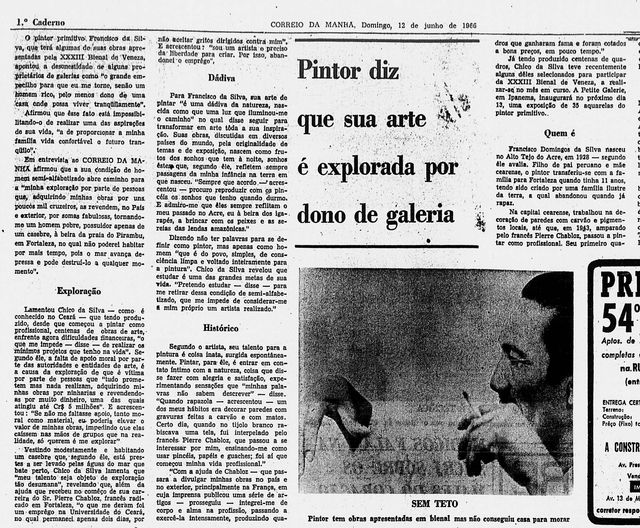
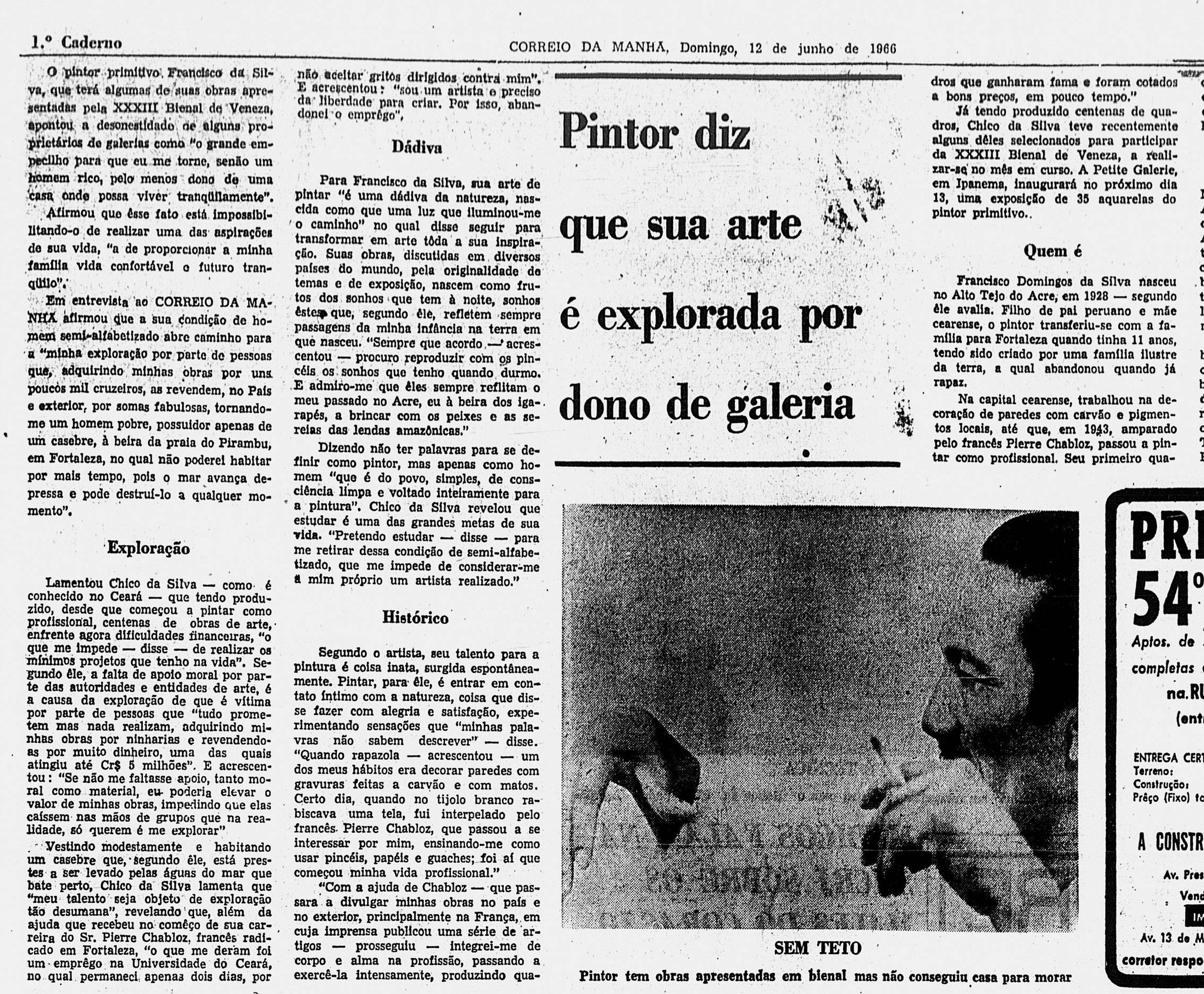
High-resolution viewer. Use the arrow keys to pan, plus and minus to zoom.
A delegation under pressure
The selection was contested from the start. Roberto Galvão, in Chico da Silva e a Escola do Pirambu, records that during a 1966 Rio exhibition of works acquired from the dealer Henrique Bluhm, the painter’s wife, Dalva da Silva, went to the Fortaleza police and denounced fakes among the pictures on show, and that Chico then publicly claimed the works as his own. Valadares came under pressure to drop him from the Brazilian delegation, pressure Galvão attributes both to prejudice against primitive art and to market interests. The critic kept him in and, by his own account, spent that season keeping Chico away from reporters. The collective studio behind the episode has its own story, told in Painting factory.
Four panels, twelve gouaches
What happened in Venice is known mostly through a letter Valadares wrote on 23 September 1966, which Galvão transcribes. Valadares says he was fought hard by fellow Brazilians hostile to Chico’s presence, that the primitives were left with minimal space, and that four panels were hung. Away from the official hanging, he showed five members of the jury the works not on view: twelve gouaches from the Museu de Arte do Ceará. In the letter, Valadares calls the honourable mention that followed a fact without precedent, in the history of an event founded in 1895, for a primitive painter. Asked for its endorsement, the Brazilian commission refused; the jury kept the citation anyway, alongside mentions for artists whose own countries had also withheld support, among them the Spanish painter Juan Genovés. Chico was not there. The paintings crossed the Atlantic without him.
Gouache, the medium of those twelve unexhibited works, stayed at the centre of what he did. Cockfight (1969), a gouache in the João Cunha Collection, is the kind of picture that carried his name in those years: two roosters face each other on a flat golden-yellow ground, claws almost touching, their plumage built from small strokes of red, blue, green, and white.

From mention to prize
The Brazilian press simplified the citation almost immediately. A caption in O Globo on 22 June 1967 said he had just won a prize at the Venice Biennale. In 1973 the same paper was exact, an honourable mention at the 33rd Biennale; in November 1977 it wrote again of the prize he had won eleven years earlier, adding André Malraux to the list of those who had recognised him, without saying when or where the French writer and former minister was supposed to have said so; no other source of the period repeats it. In 1974, also in O Globo, the critic Iaponi Araújo placed him among the primitive painters of Brazilian popular art, a group he kept separate from the naïfs. By 1977 the sociologist David A. Silberstein was measuring the cost of the consecration: Venice had been a full success, but a success for the exotic, Amazonian Chico; the northeastern observer he saw in the work was left out of the reading. The mention grew in other people’s telling. The painter’s own telling grew further.
The imaginary journeys
After 1966, Chico began to narrate journeys. Galvão’s summary is that without leaving his house or his country, he travelled the world: Germany, the United States, Paraguay, Indochina, and a country of his own invention called Juberlano. He said Queen Elizabeth had received him at Buckingham Palace. To Luiz Ernesto Kawall, in 1972, he added France, Czechoslovakia and the Philippines to the itinerary, and a painting sold in the United States for two million dollars. He told the Fortaleza daily O Povo in August 1982, in a statement Galvão collects, that Chabloz had taken him to Paris, where he met De Gaulle, a huge man in his description. To the magazine ELE/ELA in 1976: “Já fui na Inglaterra, Alemanha, no Vietcongo, nos Estados Unidos… Já fui na Juberlano.” (I have been to England, Germany, Vietcong, the United States… I have been to Juberlano.)
The rebuttal is material. During the authorship scandal of 1969, a reporter from Jornal da Tarde noted, in a passage the Ceará critic Estrigas preserved, that Chico showed his passport as proof of the journeys, and that it was blank, without a visa from any country. In November 1977 an O Globo reporter saw the same document, expired since 1967, its exit pages still empty. The passport recorded no departure.
Set beside the painting, the journeys belong to the same work. He did not report what he had lived; he invented worlds, in the naïve art the critics were trying to classify and in the life he told reporters. Juberlano is a country in exactly the way his dragons are animals.
The journey the paintings made
There was a real journey, and it belonged to the pictures. Jean-Pierre Chabloz had taken his gouaches to Europe well before Venice, to Geneva in 1949, Lisbon in 1951, Paris in 1952; that story is told in Chabloz and the discovery. In 1966 the works crossed the ocean again, and again without him. What came back to Fortaleza was the fame. What remains can be seen in the paintings and in the group of works now held by the João Cunha Collection.