The Painting Factory
How Chico da Silva's Fortaleza studio became a painting factory: mass production, forgeries and the disputed marks of the Pirambu School, 1966–1972.
The phrase came out of a newspaper column. In July 1969, closing a month of scandal, the critic José Roberto Teixeira Leite wrote in O Globo that Chico da Silva, according to the newspapers, had kept a true painting factory staffed with assistants, and reminded readers that Rubens and Caravaggio ran workshops too. Between 1966 and 1972 that factory in Fortaleza, Ceará, supplied a national market with dragons, birds and fish, and produced the questions that still follow every canvas signed Chico da Silva.
A market bigger than one hand
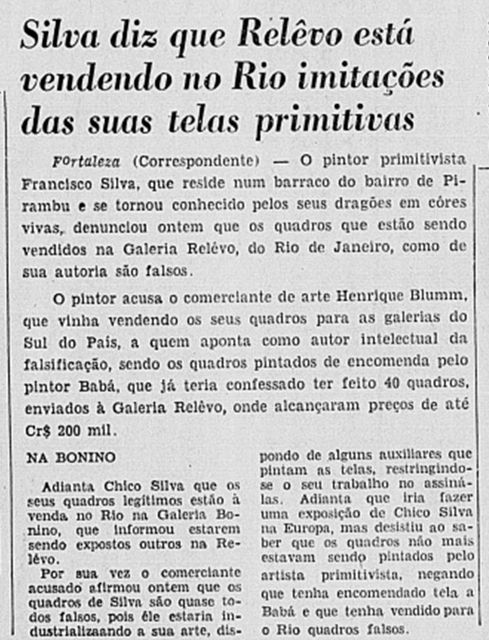
The trouble was public before the glory. In February 1966 the Jornal do Brasil reported a denunciation by the painter himself: works sold under his name at the Relevo gallery in Rio were fakes, commissioned by the dealer Henrique Bluhm from the painter Babá, who had reportedly admitted to forty of them. Bluhm answered in the same article that most paintings signed Chico da Silva were the work of assistants anyway, the master adding little beyond the signature. It was through Bluhm, records Gerciane Oliveira (2017), that the work reached the Neapolitan collector and auctioneer Giuseppe Baccaro, who put the painter up and commissioned panels from him. Four months later came the honourable mention at the 33rd Venice Biennale, and with it more demand than one hand could meet.
High-resolution viewer. Use the arrow keys to pan, plus and minus to zoom.
How the volume was organized is reconstructed by the sociologist Gerciane Oliveira, in her 2015 doctoral thesis and in the article she published in the UFC’s Revista de Ciências Sociais (2017): dealers ordered lots of fifty to eighty paintings from the young painters around Chico, and when a lot was done he came by the workshop to sign it, for sums she describes as derisory. Jean-Pierre Chabloz, who had first presented Chico’s work in the 1940s, gave his own account in 1969, in an interview picked up by the Jornal do Brasil: commissions rose until the painter worked day and night, then hired helpers; Chico, his discoverer confirmed, had created an industry of paintings. By March 1977 the Correio do Ceará put the trade at two to three thousand works a month in Fortaleza and counted some three thousand apocryphal paintings seized by the Federal Police at the stalls of the old public jail market. A year earlier the Jornal do Brasil (1976) had run the arithmetic the other way: whoever owned a Chico da Silva painted after 1972 owned, in nine cases out of ten, a fake.
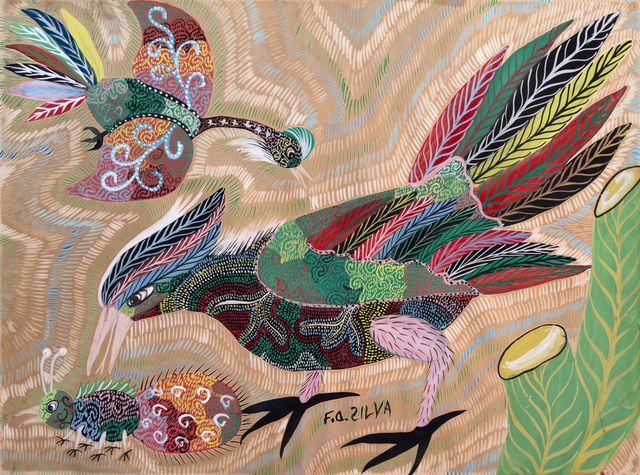
Scale changed the pictures themselves. The gouache on card of the 1950s and 60s gave way to canvas and acrylic from about 1970 on, a shift documented in the list of dated works Oliveira published in 2023. In February 1972 O Globo was still announcing a show of the painter’s gouaches at a Copacabana gallery, timed for the tourist season. Two Birds and an Insect, a gouache on paper from around 1969, shows how far the older material was carried before it gave way: a sheet 72 cm across, the long-billed bird stooping at an insect, the ground worked stroke by stroke to all four edges.
And one change has a witness: the black background. Garcia, one of the Pirambu School painters, is quoted in the 2024 collection A Escola do Pirambu: um legado de Chico da Silva (organized by Flávia Muluc) saying the black ground entered the repertoire because it sold well. A period record measures how well: in 1977 David A. Silberstein described the current production as reduced to the luminosity and colour of animal fights “against a black background”. A second version, which credits the invention to Chica, the painter’s daughter, remains a hypothesis; no document confirms it.

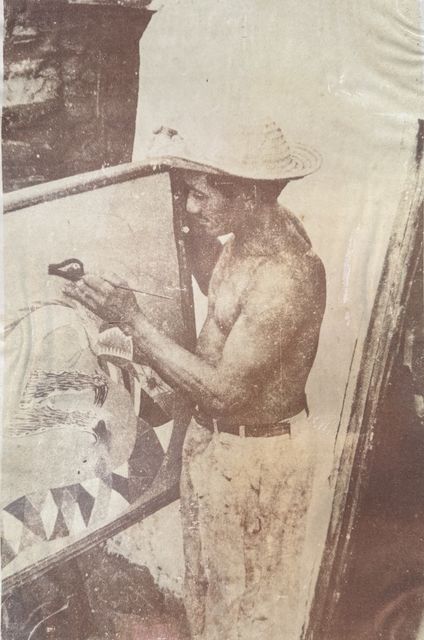
The girl who painted dragons
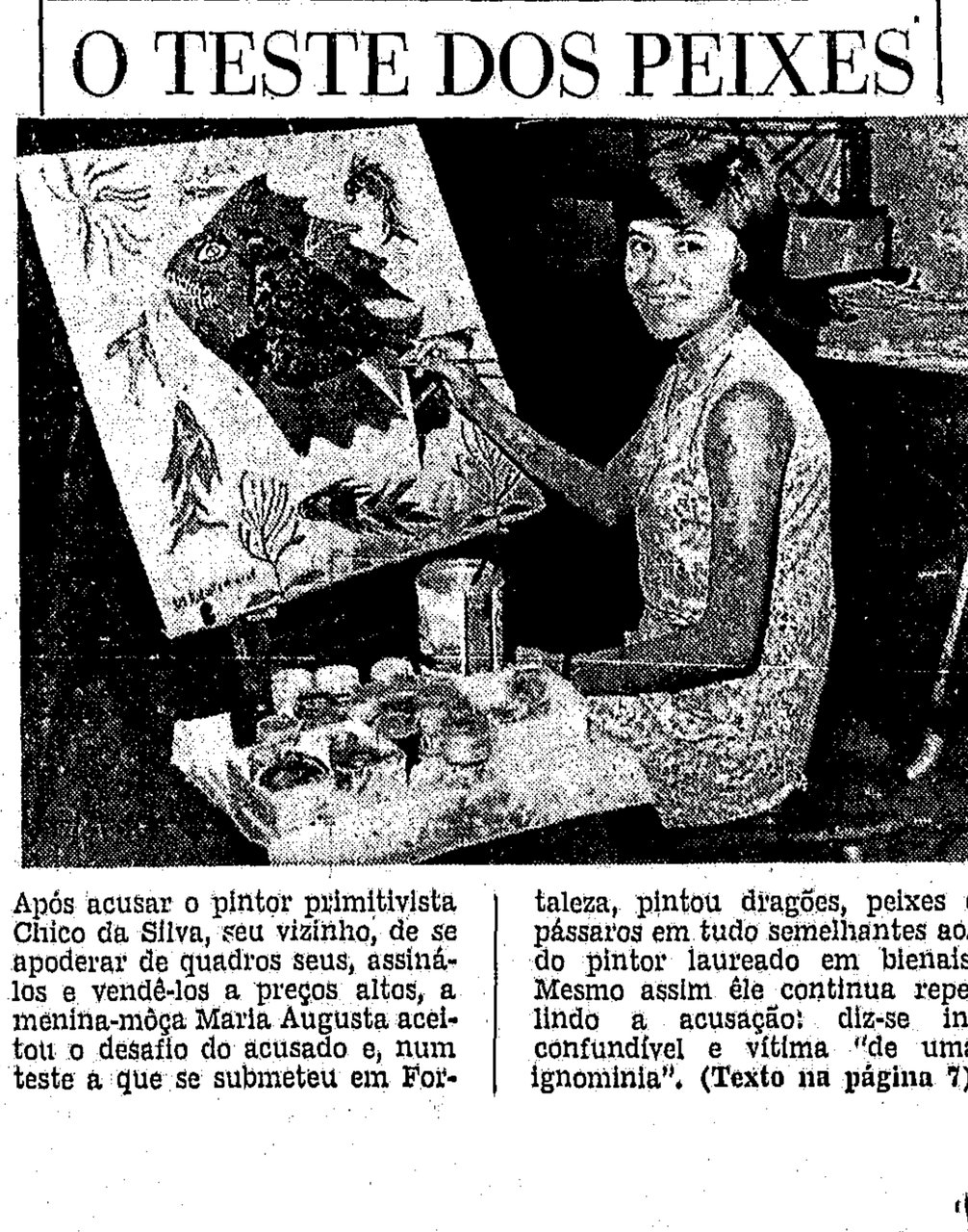
On 18 June 1969 O Globo put the case on its front page under the headline “The fish test.” Maria Augusta, a fifteen-year-old neighbour of Chico’s in Pirambu, had accused him of taking her paintings, signing them and selling them at high prices. Challenged, she sat at an easel in a newspaper office in Fortaleza and painted dragons, fish and birds in the style that had made him famous. He repelled the accusation, called it an ignominy, and held that his own manner was unmistakable.
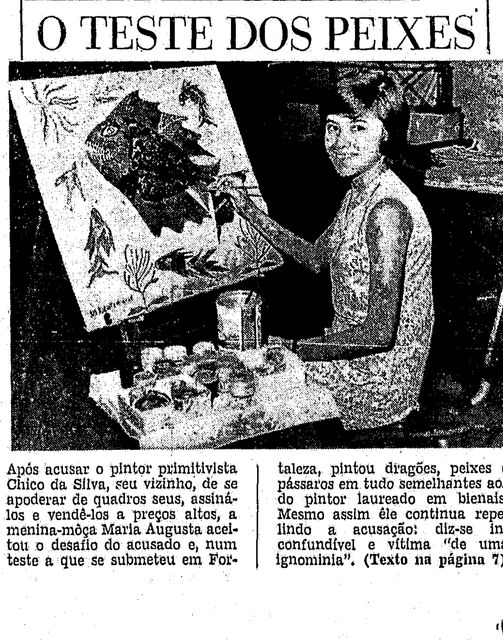
High-resolution viewer. Use the arrow keys to pan, plus and minus to zoom.
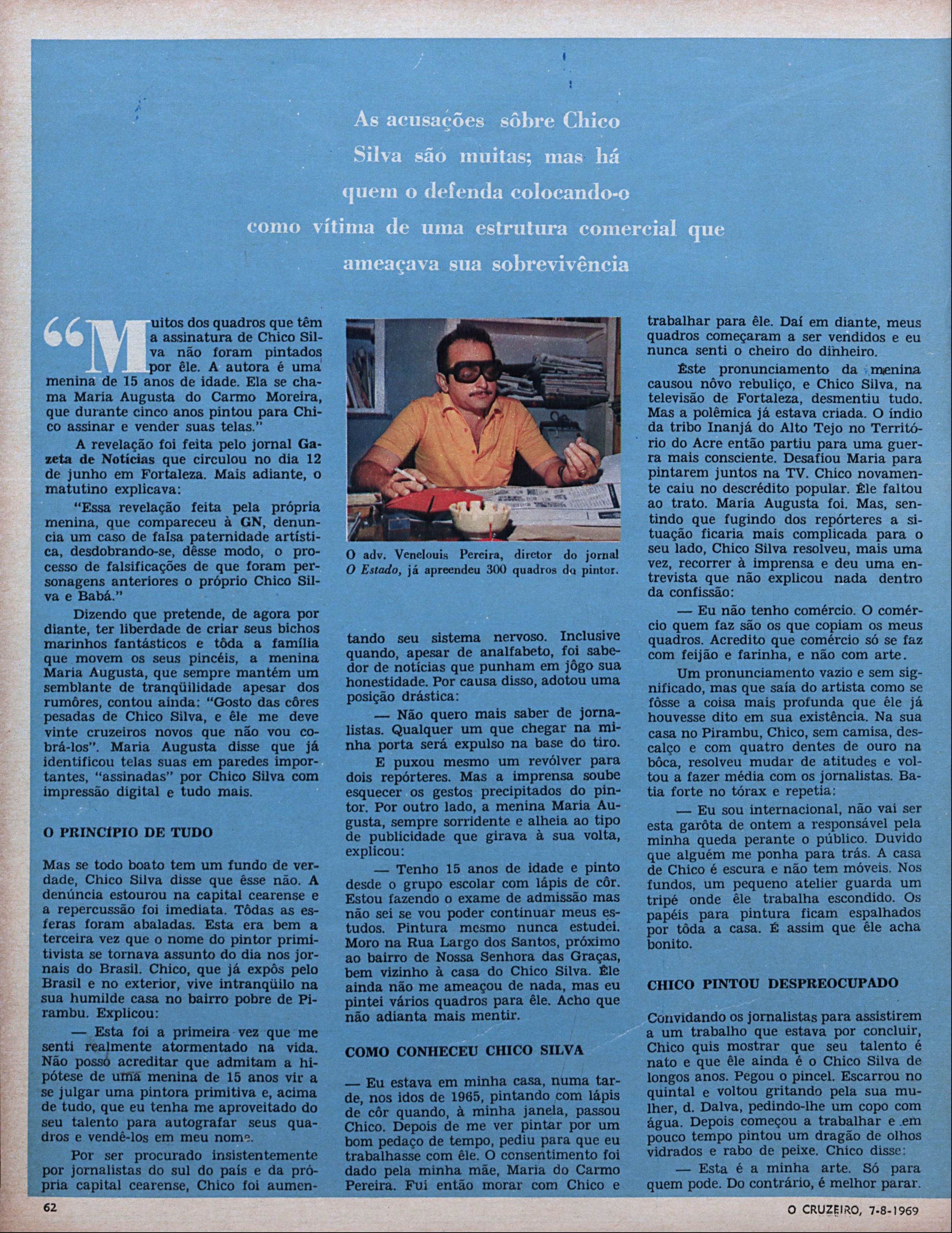
In August O Cruzeiro carried her account in the first person. Chico had seen her drawing at her window in 1965 and asked her to come work with him; from then on, she told the magazine, her paintings were sold and she never smelled the money. The same report records the sequel: he challenged her to paint beside him on television, and missed the appointment; she went. The magazine also presented Chico, in the words of its own headline, as a possible victim of a commercial structure that threatened his survival.
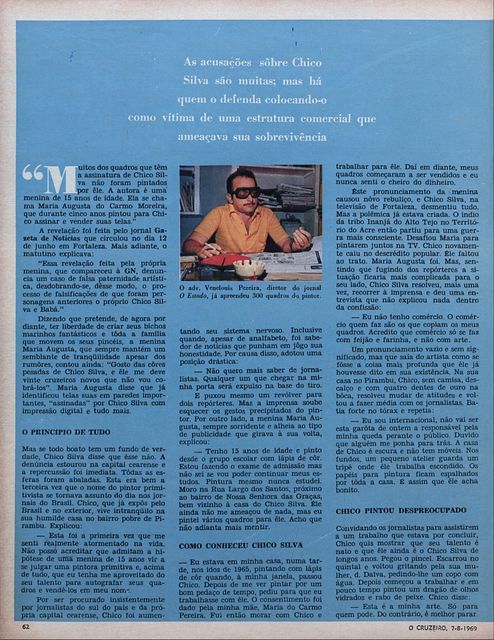
High-resolution viewer. Use the arrow keys to pan, plus and minus to zoom.
Marks against the flood
Against the copies, the studio kept marks of its own, starting with the pencil under-drawing beneath the paint, left in sketches the finished picture covered over. The painter listed them to the Correio do Ceará in 1979, adding that he sold only at home, at the Pinto Martins airport and through one gallery in Brasília.
Gerciane Oliveira (2017) inventories the arsenal of that war of marks. Painting in front of the buyer became a certificate: the house received tourists who came to watch a picture being born. In the mid-1970s the signature itself was redesigned, the F extended to underline the name, with the thumbprint pressed into the paint beside it. Then came the papers: certificates registered at a notary’s office and notarized signatures on the backs of the canvases. The police entered the circuit, one chief seizing some three hundred fake paintings and forgers being ordered to sign their own names to what they painted. None of it closed the question: the marks were copied almost as fast as they appeared. In 1972 the critic Luiz Ernesto Kawall already described fake canvases sold at hotel doors for 50 to 100 cruzeiros, with the “reversed D” signature and the thumb stamp; in 1977 Lélia Coelho Frota wrote that the “supposed fingerprint” was circulating on paintings the painter did not execute. In the market, Oliveira records, lots came to be sorted into three categories, the fake, the “half-fake” and the genuine, with the production from 1960 to the mid-1970s treated as the band of highest risk.
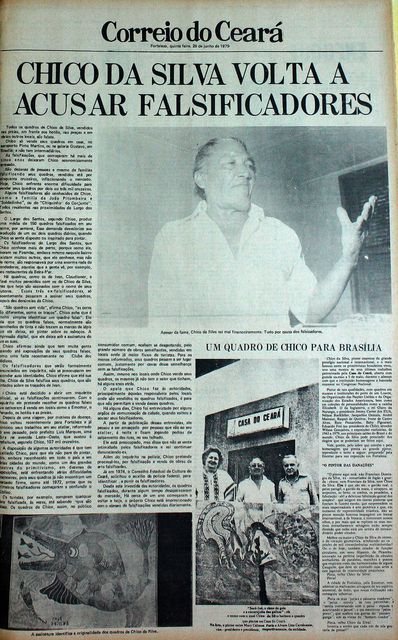
High-resolution viewer. Use the arrow keys to pan, plus and minus to zoom.
To the same paper, he explained how he told a copy from the original: fake paintings looked lifeless, he said, the colors and the brushwork different from his own. Spotting a forgery, in his view, was simple; the problem was scale. In the Loiro dos Santos alone, in Pirambu, three families were turning out some 160 paintings a week, he said, sold at the city’s tourist spots.

What the factory years left
The end of the boom has a date in print. Chico’s paintings had found a firm market until 1972, the Correio do Ceará wrote in 1979, before the first forgers confused the public. Two years earlier the same paper had welcomed an exhibition of the Pirambu painters under their own names, Babá, Claudionor, Francisca (who signs as Chica), Garcia and Ivan, as an occasion to put popular art before the public. And in the same 1979 report that listed his marks of authenticity, Chico stated that even Chica was faking his paintings. A year earlier, the dispute over the right to paint “in his manner” had gone public: on one side, friar Antônio da Memória, the painter Heloísa Juaçaba and the restorer Gilberto Brito held that for some five years Chico had not produced a painting entirely his own; on the other, the dealer Dão and the painter’s children denied it, and Chica claimed the school’s continuation for herself and her brother Roberto (Oliveira, 2017). The paradox stays open here; how the question reached the museums and the market of the 2020s is told in legacy and rediscovery.
What remains is the painting. The João Cunha Collection holds works from exactly these years, among them Dragons (1971), an acrylic on canvas, and Cockfight (1972), a gouache that carries both the signature and the pencil under-drawing beneath the paint, the marks around which the whole dispute turned. The life that runs through the factory years, from the naïve art first noticed on the walls of Praia Formosa to the international circuit, is told in the painter’s biography.