The Final Years
The final years of Chico da Silva (1970–1985): illness and hospitals in Fortaleza, late paintings, the Pirambu School dispute, his death on 6 December 1985.
In November 1970 O Estado de S. Paulo announced thirty-five canvases at the Portal gallery on Avenida Paulista and described the man who came with them: white linen suit, a top row of gold teeth, an illiterate man who spoke in parables and called a lawyer “a man of the pen” (5 November 1970). Four years after the honourable mention at the 1966 Venice Biennale, Chico da Silva could still fill a gallery in São Paulo, and the profile placed his painting where it had always been: in the childhood legends, beasts and monsters. He had fifteen years left; the press recorded nearly every station.
The years of the signature
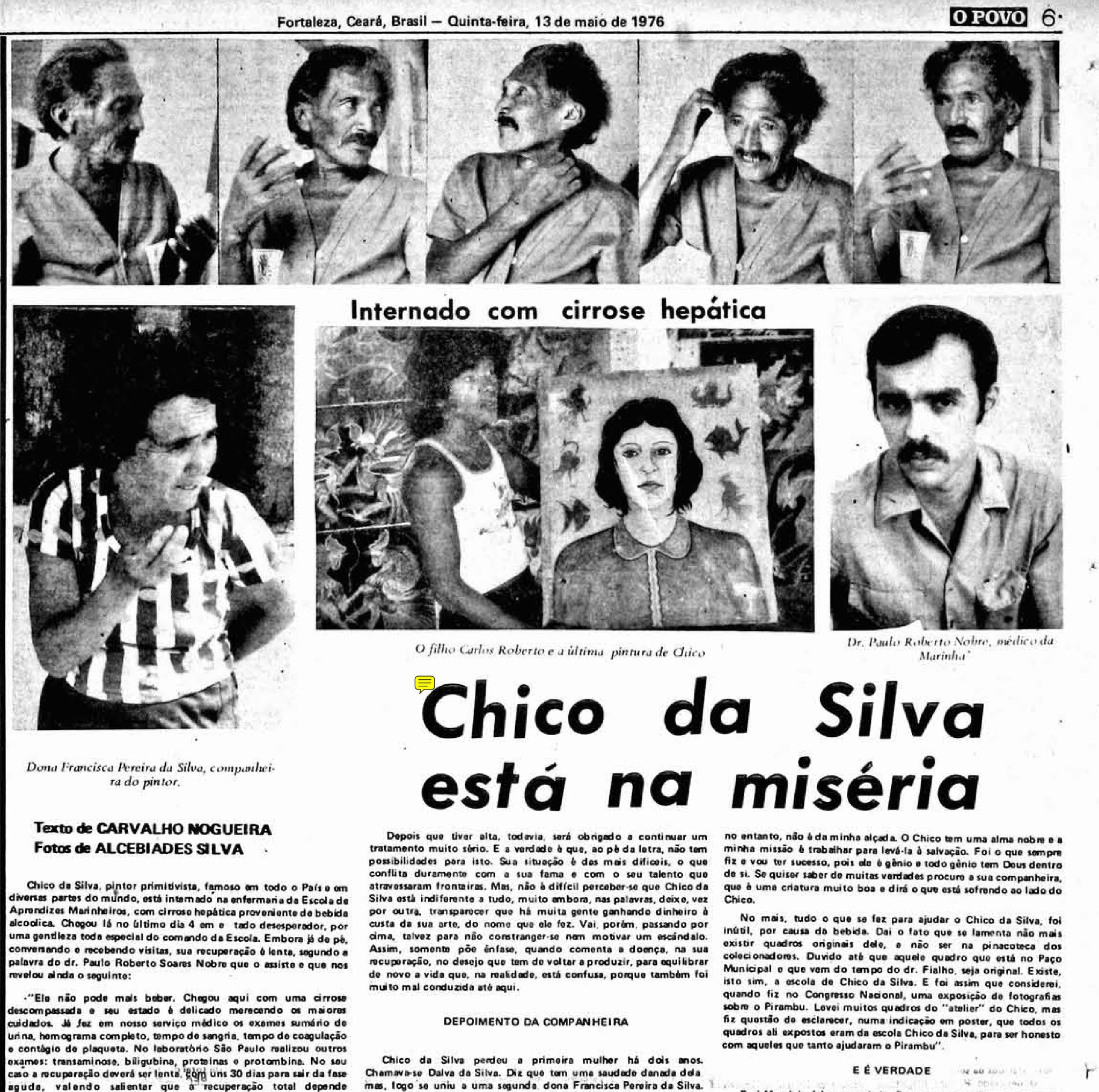
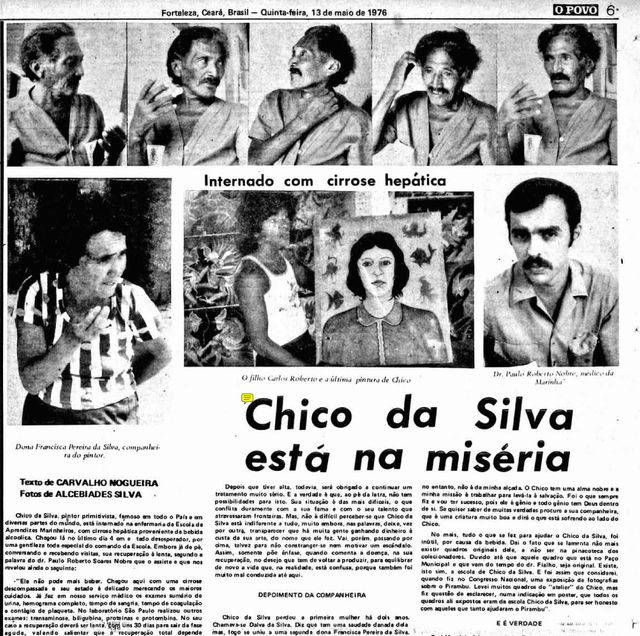
At the turn of the decade the hand behind the signature was often not his: the workshop economy of the painting factory kept dealers supplied through the young painters of the Pirambu School. He still tried to take back the reins of his own trade: in October 1972 he announced to the critic Luiz Ernesto Kawall a “Galeria Chico da Silva” on rua Tenente Lisboa, to sell without middlemen, after a dealer, he said, had vanished in Recife with sixteen million in sales. When O Povo found him drawing again in June 1976, the paper stated that he had abandoned painting in 1970 and merely signed works for small change (O Povo, 21 June 1976). His son told the same paper that the father’s last picture, a woman’s bust, was from 1974 (13 May 1976). Dalva, his first wife, died around 1974; in a 1976 interview quoted by Roberto Galvão, the painter dated his ruin from her death.
1976: the year of the hospitals
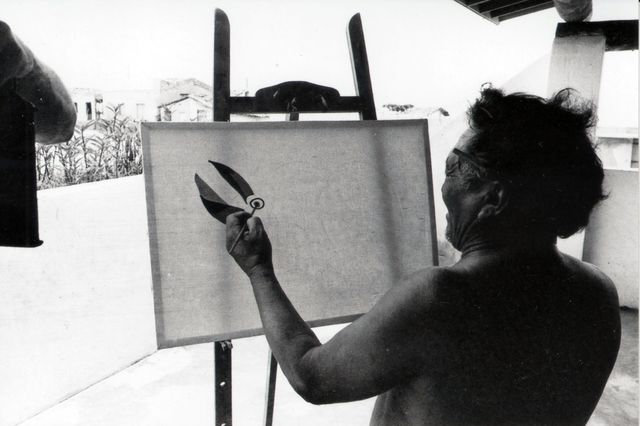
He entered the infirmary of the Naval Apprentices School in Fortaleza on 4 May 1976 with cirrhosis of the liver (O Estado de S. Paulo, 14 May 1976). O Povo opened the case under the headline “Chico da Silva está na miséria”, quoting friar Antônio Memória: the painter was dying of want (13 May 1976). On 1 June the reporter Edmar Morel published “A Máfia destruiu Chico da Silva” in the same paper, the account of a studio without brushes or paint. Mid-June found him unconscious in intensive care at the Hospital das Clínicas (O Estado de S. Paulo, 20 June 1976). On 21 June the paper photographed him in hospital whites, hand trembling, drawing sea monsters on card: his first painting, it said, in six years. In September came delirium, transfer to the Antônio de Pádua clinic and a diagnosis of alcoholic psychosis, a sequence Roberto Galvão reconstructs in the catalogue Do delírio ao dilúvio.
High-resolution viewer. Use the arrow keys to pan, plus and minus to zoom.
Selling health
He left the clinic in August 1977 in the care of Agostinho Ramirez and Francisca Margarida and went to Brasília, where he sold twenty of the forty paintings he took (O Povo, 31 August 1977). “Estou vendendo saúde”, I am selling health, ran the headline, over his promise never to return to Pirambu. By November he was in Rio, selling on the pavement. O Globo found him at the corner of Bolívar and Nossa Senhora de Copacabana, outside the Roxy cinema, ringed by onlookers all day: by Thursday morning he had sold ten canvases and painted eight, and was announcing the thirty he had brought from Ceará for the Ipanema hippie fair the next day. He asked Cr$ 500, less if you took more than one. The report set that price against the market: an imitation went for Cr$ 50 in Fortaleza, and a canvas of his from 1973 was on sale in a gallery nearby for Cr$ 1,500. He had come to prove he could still paint, annoyed at a weekly magazine that, he kept repeating, wanted to present him as though he were a banana seller. When the reporter pressed a last time on the forgers, he answered with an embolada, applauded by passers-by: “Nasci no Peru / e vim pintar no Pirambu”, born in Peru, came to paint in Pirambu, and an invitation to the imitators to come paint in the middle of the street (O Globo, 26 November 1977). The comeback was uneven. In March 1978 he opened his first São Paulo show in five years (O Estado de S. Paulo, 14 March 1978); in April, twenty-eight of those canvases disappeared with the gallery’s owner and he went to the police (O Povo, 3 April 1978). In August the mayor of Fortaleza returned, rebuilt, the house-studio on Avenida Leste-Oeste that governor César Cals and mayor Vicente Fialho had ceded him at the end of 1974, to use for as long as he lived (Oliveira, 2017), and he prepared twelve canvases for the first Latin American Biennial (O Povo, 13 August 1978). Galvão adds the Anchieta Medal from São Paulo’s city council and three exhibitions in 1979 at prices he calls degraded. In 1980 the painter went to court against the forgers: the judge appointed Henrique Barroso and Roberto Galvão as experts, the case stalled, and Chico took to authenticating his canvases at a notary’s office (Galvão, Chico da Silva e a Escola do Pirambu). That same year Jean-Pierre Chabloz, the discoverer of 1943, attacked Brazilian primitivism in the Rio press; the Fortaleza response (O Estado de S. Paulo, 9 November 1980) counted more than fifteen months of psychiatric internment behind the painter and three extreme unctions.
The left hand
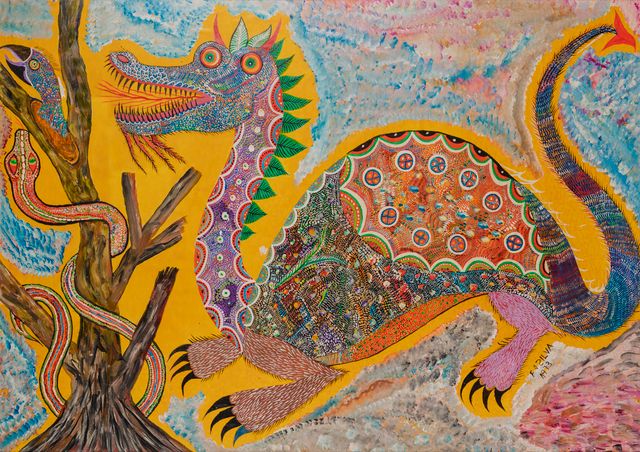
A thrombosis in February 1981 kept him in bed for more than eight months and paralyzed his right side. He was left-handed and kept painting (Galvão, Do delírio ao dilúvio). Through Luíza Távora, then first lady of Ceará, he obtained a shop-studio at the Pinto Martins airport; in June 1983 came, by law, a state pension of two minimum salaries. That October O Povo described a man of halting speech who would not stop, and quoted his doctor: the art kept him alive (13 October 1983). The market treated his peers better than it treated him: at the Fortaleza auctions of 1983, canvases by Antônio Bandeira and Aldemir Martins went for 1.1 and 1.6 million cruzeiros; a Chico da Silva, for twenty thousand (Oliveira, 2017). Eleven years earlier it was against those two that he measured himself, boasting to Kawall that he was the Brazilian painter who painted the most, more even than Aldemir and Bandeira. Convalescing, he called himself someone come out of “um prolongado dilúvio”, a prolonged deluge; Galvão took the word for the title of his catalogue of the 1977–1982 production, acrylic on canvas now instead of the gouache of the Chabloz decades, the repertoire intact: fighting roosters, dragons, fish. The João Cunha Collection holds paintings from this last period, among them the 1983 Cockfight reproduced here.

In February 1984 he went to São Paulo for a check-up and treatment of the thromboses in his leg, staying with his sister, Francisca, and his cousin Esmeralda in a plain hotel room downtown. He had trouble speaking and went on painting. In his luggage he brought nine canvases of 70 by 90 centimetres at Cr$ 300,000 each, six of 50 by 70 at Cr$ 200,000, and five paper panels valued at between three and ten million cruzeiros. It was his sister who spoke to the press: there was not one original of his in São Paulo, and gallery owners bought copies in Fortaleza for two or five thousand cruzeiros to resell at a hundred and fifty thousand. At the family’s request the police had seized more than six hundred fake paintings between 1982 and 1983. She counted twelve imitators in Pirambu and put the difference in a measure of time: they turned out ten paintings a day with the whole family working, and her brother took two days over a large one (O Globo, 25 February 1984).
On 28 March 1984 governor Gonzaga Mota carried the Medalha da Abolição, the highest decoration of Ceará, to the sickroom on Avenida Heráclito Graça (O Povo, 28 March 1984; O Estado de S. Paulo, 29 March 1984). The house promised on that occasion came at the start of 1985, after a bureaucratic impasse O Povo itemized in October 1984.
6 December 1985
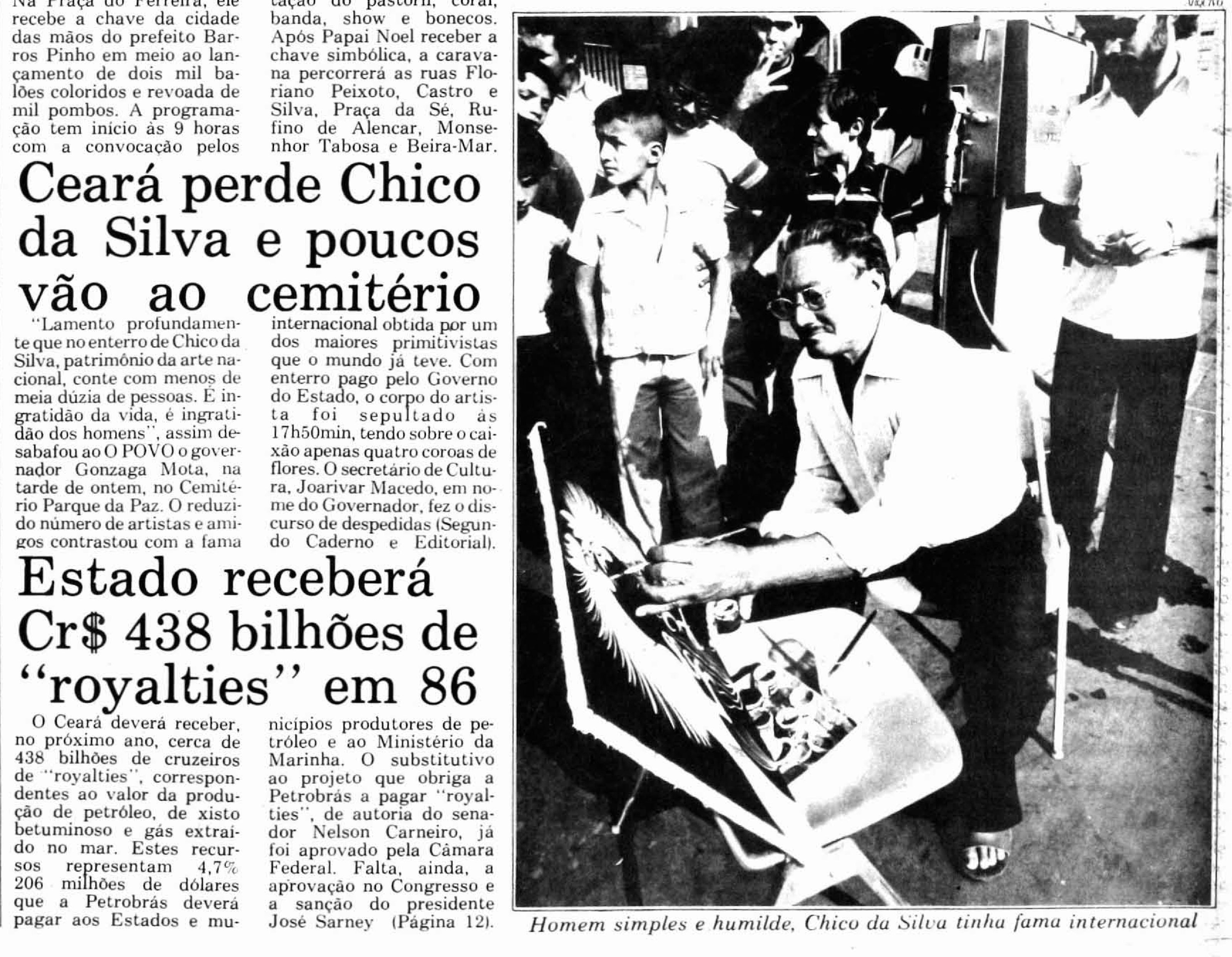
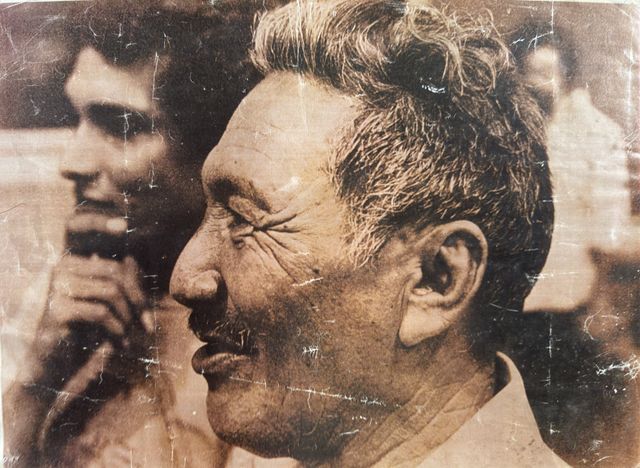
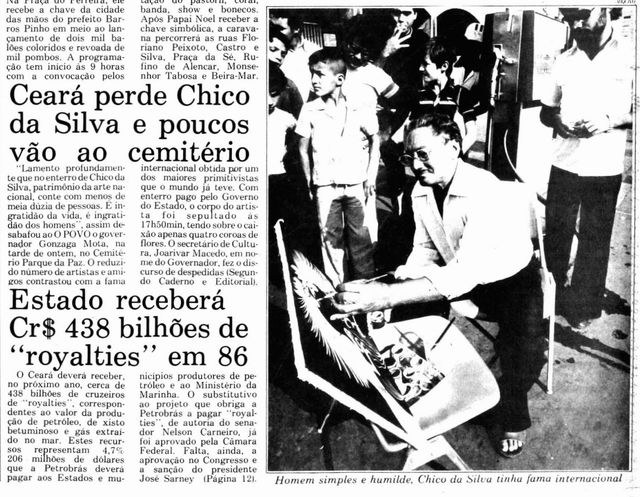
Chico da Silva died at 3:20 in the morning of 6 December 1985, at the Policlínica in Fortaleza. The obituary in O Povo transcribed the admission sheet: entry on 2 December, chronic pulmonary emphysema, then a stroke (7 December 1985). The obituaries gave his age as 75; his birth was never firmly dated (estimates run from about 1910 to 1922). The body was waked at the Casa de Cultura Raimundo Cela and buried the same afternoon at the Parque da Paz cemetery, in a plot paid for by the state, four wreaths on the coffin; the front page kept the governor’s word for the thin crowd: ingratitude. The same wire obituary ran in O Estado de S. Paulo and in the Jornal do Dia of Cuiabá, under the headline “Morreu um dos maiores primitivistas do Brasil”. Beside the obituary the paper printed sayings compiled by Roberto Galvão, one of them a forecast: “Enquanto for vivo, tenho valor e se morrer terei valor dobrado”, alive I have value, dead it will double.
High-resolution viewer. Use the arrow keys to pan, plus and minus to zoom.
Estrigas, who closed his 1988 biography with the funeral, notes that discoverer and discovered ended a few steps apart: Chabloz, dead in Fortaleza in June 1984, lies in the same cemetery. What came after, the slow return of the work to museums and to the histories of Brazilian popular art and naïve art, is the subject of Legacy and rediscovery. The road that led here, from the Alto Tejo to the walls of Praia Formosa, is told in the painter’s biography.